
Apple A20 Pro: Record Single-Thread Score, Six-Core Limits
Early Geekbench 7 data puts the A20 Pro's single-thread speed ahead of desktop CPUs, while multi-thread scores, battery gains and entry-level tablet tiers are less settled.
Contents
- What the A20 Pro is: a flagship 2026 chip with a promising early reception
- How fast is the A20 Pro in single-thread work against desktop and laptop CPUs?
- Does six-core multi-thread performance hold up against laptop and PC CPUs?
- How much faster is the A20 Pro than its predecessor?
- How does the A20 Pro stack up against rival flagship phone chips?
- What scores does the A20 Pro get in AnTuTu, Geekbench and 3DMark?
- AnTuTu: a 3.43 million total, with user runs from about 3.43 to 3.66 million
- Geekbench CPU results: the early 4,006 / 11,460 submission next to user runs
- Graphics benchmarks: three 3DMark scores and one Geekbench GPU result
- Apple's own claims: AI up to 4.5x, graphics up to 2.7x and multithreaded CPU up to 60% higher
- Does the 2 nm TSMC process make the A20 Pro more energy efficient and help battery life?
- A20 Pro CPU: six cores, two Super cores at up to 4.93 GHz and four efficiency cores at 2.64 GHz
- GPU and Neural Engine: a 7-core GPU with 896 shaders, a Neural Accelerator in each core and a 32-core NPU
- Memory support: up to 12 GB with 115.2 Gb/s of bandwidth
- Camera, video, audio and storage support: 3x 48MP cameras and 4K at 120 FPS
- Connectivity: modem, 5G, Wi-Fi, Bluetooth and satellite navigation
- Where the A20 Pro ships, and how the 5-core and 512 GB variants differ
- Who the A20 Pro suits, and who should hold off
One early benchmark run gave the A20 Pro a single-thread score that Tom's Hardware says beats the leading AMD and Intel desktop CPUs by up to 32%. The same run leaves its six-core multi-thread result behind Apple's own M-series chips, even the M3, and that split decides who should care about this chip. Both figures come from a submission the publication warns may not match shipping products, so the sections below weigh how much each number can carry.
What the A20 Pro is: a flagship 2026 chip with a promising early reception
The A20 Pro is a flagship chip in the , announced in September 2026; Nanoreview and Notebookcheck both give the exact date as September 9, 2026. Its model number is APL1Y01.
Early opinion is positive but light. GSMArena's iPhone 18 Pro review calls the silicon promising and asks whether it can deliver better battery life as well as better performance, while Notebookcheck's page describes it as a powerful new SoC. Both remarks are general impressions rather than test results, and the benchmark sections that follow are where they get checked.
How fast is the A20 Pro in single-thread work against desktop and laptop CPUs?
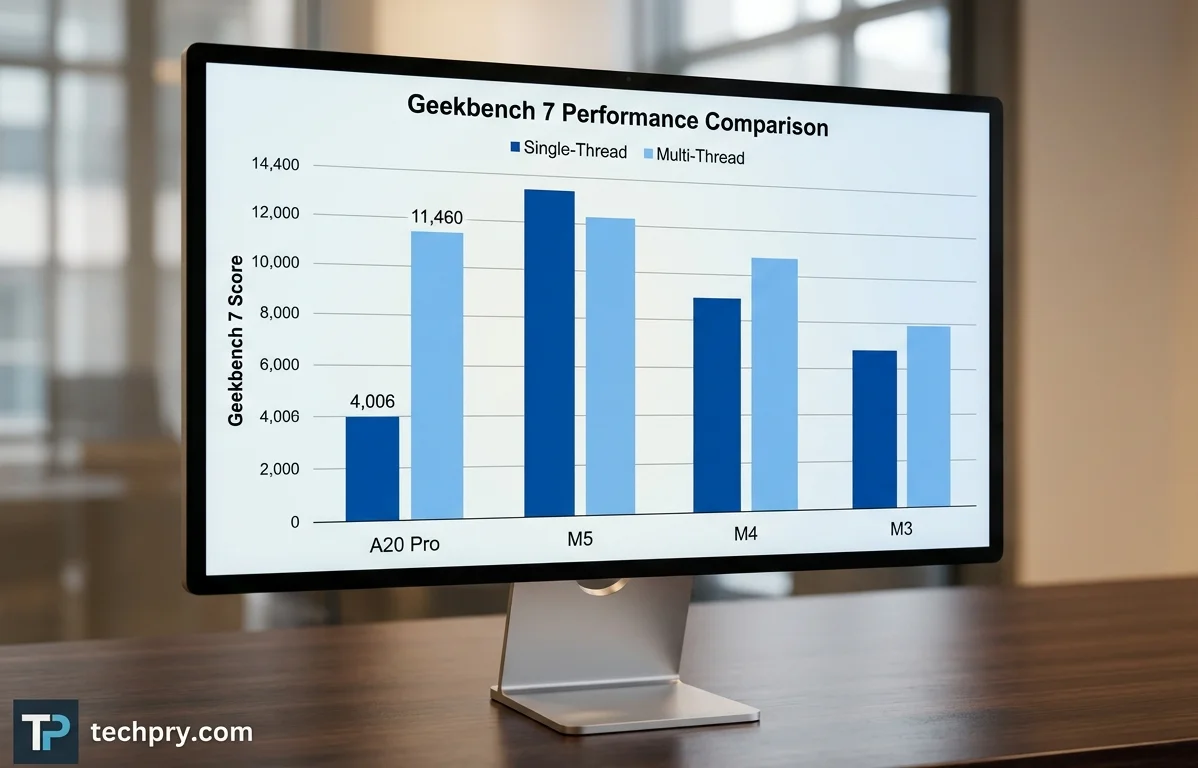
Very fast, on paper. An early submission gives the A20 Pro 4,006 points single-thread, which Tom's Hardware reads as 26% ahead of AMD's and 32% ahead of Intel's .
The same comparison has Apple's own chips below it: 3,739 for the M5, 3,351 for the M4 and 2,808 for the M3. Tom's Hardware describes the result as setting a record for single-thread performance, and Notebookcheck's page points the same way, calling the single-core performance particularly impressive and saying Geekbench puts the chip ahead of all desktop and laptop competitors and on par with Apple's M6. The hardware makes the result less surprising than it sounds: Tom's Hardware calls the two Super cores desktop-class, and they run at up to 4.93 GHz.
Single-thread speed decides how quickly one demanding task finishes, so it is the number most likely to show up as a phone that feels quick. The catch is where the figure comes from: one early submission that Tom's Hardware says may or may not reflect actual A20 Pro products. Read 4,006 as a strong preview, not a final rating.
Does six-core multi-thread performance hold up against laptop and PC CPUs?
Partly. The early submission scores 11,460 points multi-thread , which Tom's Hardware says is still faster than mainstream laptop CPUs even when many threads are involved. The same analysis adds that high-end PC CPUs still have the edge in multi-threaded workloads.
Inside Apple's lineup the picture is less flattering. The reaches 18,671 and the 15,806 in the same comparison, and even the M3's 12,061 is above the A20 Pro's 11,460.
Set that beside the single-thread results and the A20 Pro tops the list on one measure and finishes last of the four on the other. The layout explains it: six cores, only two of them clocked at up to 4.93 GHz and the other four at 2.64 GHz. That is a profile built for quick, bursty work more than for long jobs that keep every core busy, which is exactly where Tom's Hardware's caveat about high-end PC chips applies.
How much faster is the A20 Pro than its predecessor?
Between roughly 23% and 30%, depending on who measures. Tom's Hardware's early Geekbench 7 comparison puts the A20 Pro 23.3% ahead of the in single-thread and 27.1% ahead in multi-thread , while Notebookcheck reports around 30% higher performance in its own benchmarks, given as one overall figure.
Tom's Hardware calls this the largest generational uplift Apple has delivered in years and credits architectural enhancements and significantly higher clock speeds, with the usual caveat that the data comes from an early submission. Notebookcheck also notes that the integrated GPU has one more core than the A19 Pro's, so graphics get a hardware bump as well.
Two outlets landing in the same range makes the size of the jump more believable than either figure alone. Note the limit, though: the multi-thread gain (27.1%) is bigger than the single-thread gain (23.3%), yet the A20 Pro still sits below the M5, M4 and M3 on multi-thread, so the generational step does not close that gap.
How does the A20 Pro stack up against rival flagship phone chips?
In Tom's Hardware's early Geekbench 7 comparison, the A20 Pro beats every rival flagship phone chip listed in single-thread and all but one in multi-thread. The , and all land behind it on both counts, while the is behind in single-thread but ahead in multi-thread, where the A20 Pro trails it by 2.7%.
| Chip | Single-thread | A20 Pro lead | Multi-thread | A20 Pro lead |
|---|---|---|---|---|
| A20 Pro | 4,006 | – | 11,460 | – |
| Snapdragon 8 Elite Gen 5 | 3,047 | 31.5% | 10,212 | 12.2% |
| Xring O3 | 2,996 | 33.7% | 11,777 | −2.7% |
| Exynos 2600 | 2,694 | 48.7% | 10,580 | 8.3% |
| Dimensity 9400 | 2,273 | 76.2% | 7,745 | 48.0% |
| Tensor G5 | 2,011 | 99.2% | 5,859 | 95.6% |
| Kirin 9050 Pro | 1,028 | 289.7% | 4,794 | 139.0% |
Tom's Hardware sums this up by calling the A20 Pro currently the highest-performing mobile application processor. The table backs that more firmly for single-thread than for multi-thread. The single-thread lead runs from 31.5% over the Snapdragon to 289.7% over the Kirin, but the multi-thread cushion over the two closest Android rivals is thin: 12.2% over the Snapdragon and 8.3% over the Exynos, with the Xring O3 slightly ahead. For a buyer comparing phones, the A20 Pro's edge should be most visible in single-thread work, while heavy multi-core tasks are where the best Android chips stay close.
What scores does the A20 Pro get in AnTuTu, Geekbench and 3DMark?
The numbers come from three different kinds of material, and they deserve different weight: totals listed on spec pages, individual user-submitted runs, and one early Geekbench 7 submission that Tom's Hardware warns may not match finished products. Spec-page totals show where the chip lands, user runs show how much results scatter, and the early submission is the only one that arrives with rivals alongside it. The three parts below keep them apart.
AnTuTu: a 3.43 million total, with user runs from about 3.43 to 3.66 million
The total is 3,434,654, built from a CPU score of 879,839, a GPU score of 1,407,166, a memory score of 418,755 and a UX score of 728,894. The GPU component is the biggest of the four, so graphics carry more of this total than the CPU does.
Nanoreview's list of user tests adds three individual runs:
| Tester | Date | Score |
|---|---|---|
| Ianzzzz | September 24, 2026 | 3,659,652 |
| Bears lover | October 19, 2026 | 3,651,257 |
| sammzz | October 22, 2026 | 3,429,537 |
Two of the three runs land well above the 3,434,654 total, and the third sits almost exactly on it. A spread like that is normal for user-submitted runs, where devices, temperatures and settings differ, so a single AnTuTu screenshot is a weak basis for a purchase.
Geekbench CPU results: the early 4,006 / 11,460 submission next to user runs
The early Geekbench 7 submission shows 4,006 single-thread and 11,460 multi-thread points , and Nanoreview's list has a user run on the same version, from zsc on October 4, 2026, at 4,047 / 11,701. Two results that close suggest the early submission was not an outlier, though Tom's Hardware's warning that it may not reflect actual products still stands. The remaining entries are runs by one tester, Libero.
| Version | Source | Date | Result as listed |
|---|---|---|---|
| Geekbench 7 | Early submission (Tom's Hardware) | – | 4,006 / 11,460 |
| Geekbench 7 | zsc | October 4, 2026 | 4,047 / 11,701 |
| Geekbench 6 | Libero | September 25, 2026 | 4,707 / 12,705 |
| Geekbench 6 | Libero | October 14, 2026 | 4,739 / 12,815 |
| Geekbench 6 | Libero | October 14, 2026 | 4,738 / 12,831 |
Libero's three Geekbench 6 runs are tightly clustered, from 4,707 to 4,739 on the first value and 12,705 to 12,831 on the second, across two different dates. They read higher than the Geekbench 7 pairs, which most likely reflects how the two versions score rather than a faster chip, so numbers from one version should only be compared with rivals on the same version.
Graphics benchmarks: three 3DMark scores and one Geekbench GPU result
The A20 Pro's 3DMark scores are 4,263 in , 17,850 in and 9,024 in . Libero's Geekbench 6 GPU run on September 25, 2026 came in at 65,077.
These are four numbers on four different scales, so none can be set against another. Each becomes useful only once you find another chip's score on the same test. The one cross-check available is the AnTuTu GPU component of 1,407,166, the largest slice of that benchmark's total.
Apple's own claims: AI up to 4.5x, graphics up to 2.7x and multithreaded CPU up to 60% higher
Apple says the A20 Pro in its new OLED tablet, announced on October 26, 2026, runs AI up to 4.5 times faster than the previous generation, graphics up to 2.7 times faster and multithreaded CPU performance up to 60% higher, according to pasqualepillitteri.it's report of the announcement.
Treat these as manufacturer ceilings: every one is an 'up to' figure. Apple frames them as gains over the previous generation, and the coverage does not present them as a comparison with the A19 Pro, so the 60% multithreaded claim should not be set beside the 27.1% multi-thread gain from the early submission. The third-party gains for the chip itself, 23.3% to 27.1% in Tom's Hardware's run and around 30% in Notebookcheck's, are the more conservative guide to what changed from the A19 Pro.
Does the 2 nm TSMC process make the A20 Pro more energy efficient and help battery life?
It points that way, but so far the efficiency case is an expectation, not a measurement. The A20 Pro is made by TSMC on a 2 nanometer process , and Notebookcheck expects excellent energy efficiency because the chip is built on .
On battery life, GSMArena's iPhone 18 Pro review says it does not expect major gains from the phone's fairly negligible capacity bump and suggests the new SoC and software might help. That is a tentative hope from one review, and it concerns a phone's battery rather than the chip's power draw measured on its own.
One thing to watch: Tom's Hardware credits part of the performance uplift to significantly higher clock speeds, and the chip peaks at 4.93 GHz. Higher clocks cost power, so the process gain could be spent on speed instead of endurance. Until someone publishes battery or power-draw measurements, efficiency is likely but unproven.
A20 Pro CPU: six cores, two Super cores at up to 4.93 GHz and four efficiency cores at 2.64 GHz
The CPU has six cores: two high-performance 'Super' cores (S-cores) at up to 4.93 GHz and four efficiency cores at 2.64 GHz. It runs the instruction set, has 192 KB of L1 cache and 16 MB of L2 cache, and supports 64-bit.
One line in Notebookcheck's description conflicts with the spec: its prose says the efficiency cores run at up to 4.9 GHz, but the spec lists 2.64 GHz and Notebookcheck's own table shows 2.6 GHz, so the prose looks like a slip and the spec figure is the one to trust. Tom's Hardware writes the same layout as 2P+4E, up to 4.93 GHz.
GPU and Neural Engine: a 7-core GPU with 896 shaders, a Neural Accelerator in each core and a 32-core NPU
The graphics hardware is a 7-core design called the Apple A20 Pro GPU. Notebookcheck says it has one more core than the A19 Pro's, and pasqualepillitteri.it says each core carries a Neural Accelerator.
| Item | Value |
|---|---|
| GPU name | Apple A20 Pro GPU |
| Architecture | Apple A GPU |
| Frequency | 1620 MHz |
| Pipelines | 7 |
| Shading units | 128 |
| Total shaders | 896 |
| Compute performance | 2903 Gigaflops |
The shader numbers hang together: seven pipelines at 128 shading units each multiply out to the 896 total.
The neural processor is the . Notebookcheck says it has 32 cores in two units, and coverage of Apple's October 2026 tablet launch mentions a doubled 16-core Neural Engine for the top storage tier, which would add up to the same 32 cores counted as two units of 16.
Memory support: up to 12 GB with 115.2 Gb/s of bandwidth
The chip supports memory at 4800 MHz, up to 12 GB, with a maximum bandwidth of 115.2 Gb/s. The bus is listed as 3x 32 bit, and Tom's Hardware describes the interface as allegedly 96-bit, which is the same width.
Tom's Hardware says the interface delivers 50% higher memory bandwidth than its predecessor, a gain that matters most for graphics and AI work, where moving data often limits speed.
Two cautions apply. The 12 GB figure is the most the chip supports, not what any given phone or tablet ships with. And pasqualepillitteri.it says the 512 GB tier of Apple's new tablet gets a configuration with more memory bandwidth, so bandwidth can differ between versions of the chip.
Camera, video, audio and storage support: 3x 48MP cameras and 4K at 120 FPS
The media block supports up to 3x 48MP cameras, 4K video capture and playback at 120 FPS, and storage. On the codec side, sits alongside H.264 and H.265, which covers both older and newer streaming formats.
- Video codecs: H.264, H.265, AV1, VP8, VP9 and Motion JPEG.
- Audio codecs: AAC, AAX, AAX+, AC-3, AIFF, CAF, E-AC-3, MP3, MP4 and WAV.
These are limits of the chip: the camera and storage hardware a device actually ships with is the maker's choice.
Connectivity: modem, 5G, Wi-Fi, Bluetooth and satellite navigation
The A20 Pro pairs with the modem and supports 5G, and . Navigation covers six systems: GPS, GLONASS, Beidou, Galileo, QZSS and NAVIC.
Where the A20 Pro ships, and how the 5-core and 512 GB variants differ
The A20 Pro powers Apple's latest iPhones, the H2 2026 models, and is also used in the . Notebookcheck lists the 512GB iPad Mini, and pasqualepillitteri.it describes the new OLED iPad mini announced on October 26, 2026.
The chip comes in more than one configuration. Notebookcheck lists an Apple A20 Pro 5-Core at 4.93 GHz with five cores, and pasqualepillitteri.it says the 128 and 256 GB iPad mini tiers have a 5-core CPU. The 512 GB tier gets a different configuration with more memory bandwidth and a doubled 16-core Neural Engine, per that report, which lines up with Notebookcheck's 32-core, two-unit description of the NPU.
For buyers, that makes the six-core benchmark figures above a ceiling for the entry tiers, which have one CPU core fewer; which core is removed is not specified. Single-thread results should stay close because the 5-core variant is listed at the same 4.93 GHz peak clock, while multi-thread results are the part likely to drop.
Who the A20 Pro suits, and who should hold off
Buyers who want a phone or tablet that feels fast in everyday single-threaded work have the strongest case, since the early data puts the A20 Pro ahead of desktop CPUs and every phone rival listed on that measure. Current connectivity comes with it too: 5G, Wi-Fi 7 and Bluetooth 6.0.
Wait for measurements if the decision hinges on sustained multi-core horsepower, where Apple's M-series chips and high-end PC CPUs stay ahead ; on battery life, which so far rests on expectations ; or on one of the 5-core tablet tiers, where the six-core benchmark figures do not apply directly. Every performance number here also rests on early data that may not reflect shipping products.
Comments 0
Please log in or sign up to comment.