
Apple M5 (iPad): A Graphics-First Upgrade Over the M4
In PCMag's runs the M5 gains about 6 to 13 percent on the CPU and 27 to 54 percent in graphics over the M4, so the upgrade case rests on what you own now.
Contents
- How fast is the M5 next to rival tablets?
- How much faster is the M5 than the M4 in the iPad Pro?
- M5 vs M4 benchmark scores in PCMag's tests
- Is the M5 worth it over the 2024 iPad Pro or an M1 model?
- Apple's headline speed claims and what they leave out
- Connectivity: the first tablet with Apple's C1X modem and N1 chip
- Cellular: what the C1X modem covers and what it skips
- Wireless networking: what the N1 chip changes
- Location: which satellite systems are listed, and on which models
- AI hardware: 16 neural-engine cores plus an accelerator in each GPU core
- Apple's claimed AI gains: 3.5 times faster than the M4
- CPU: ten cores in a 4-plus-6 split, with a 9-core variant
- GPU: 10 cores at 1620 MHz with 1,280 shaders
- Synthetic graphics scores listed for the M5
- Memory and bandwidth: what changed from the M4
- RAM by storage tier, and how fast the storage is
- Media engine, codecs and maximum display resolution
- When was the M5 announced, and what is its model number?
- Who the M5 iPad Pro suits and who can skip it
Reviewers call the M5 the fastest tablet, yet its step up from the M4 is smaller on the CPU than that headline suggests: PCMag's runs put the gain at roughly 6 to 13 percent, against roughly 27 to 54 percent in the two graphics tests. Around that sit radios Apple now makes itself, 12GB of RAM on the cheaper storage tiers and AI hardware inside the GPU, so the chip's value depends mostly on what you are upgrading from.
How fast is the M5 next to rival tablets?
Reviewers rank the M5 iPad Pro as the fastest tablet. Two of the three reviews of it say so: ITPro ties the year's top tablet benchmark result to the iPad Pro's flagship processor, and a video reviewer whose transcript is on GoTranscript calls it a faster version of what was already the quickest tablet around.
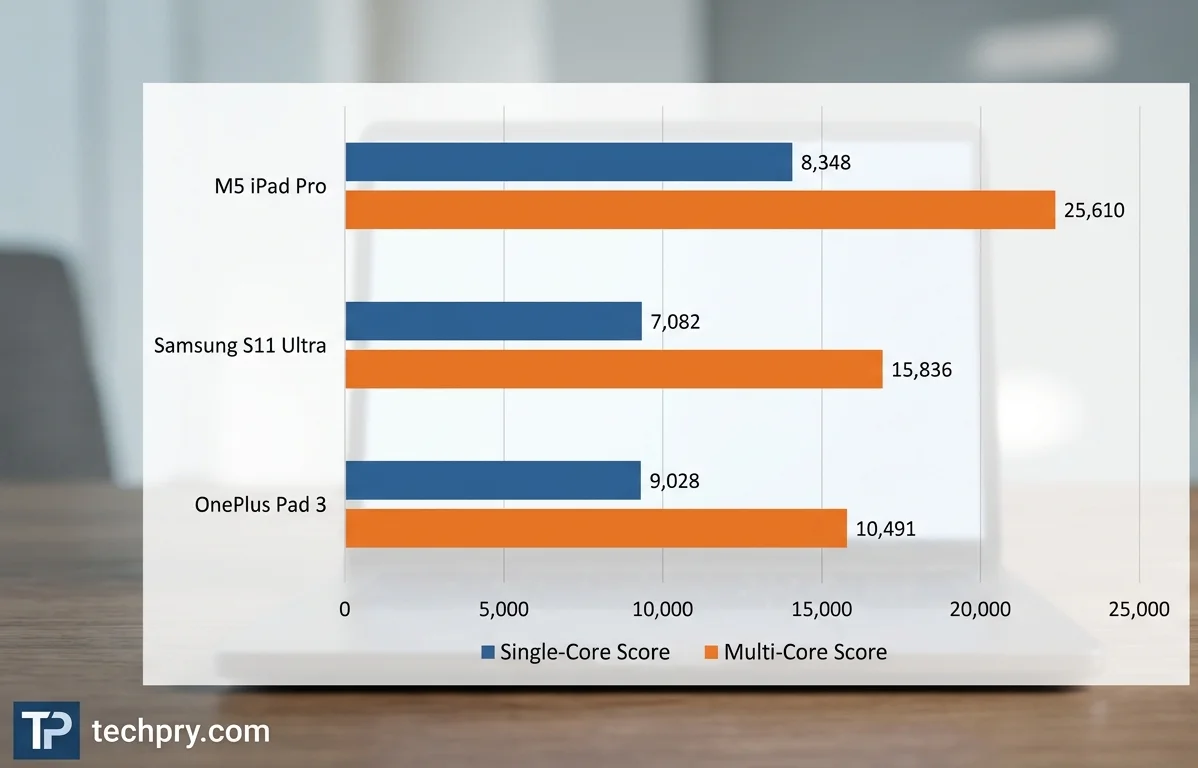
ITPro's run supplies the numbers: 4193 single-core and 16777 multi-core. Its text labels the chip ‘M5 Pro’ in that sentence, which reads as a slip, since the review covers the iPad Pro. The comparison tablets were Samsung's S11 Ultra, with a Mediatek 9400+ chip, and the , with a processor.
| Tablet | Single-core score | Multi-core score |
|---|---|---|
| iPad Pro (M5) | 4193 | 16777 |
| Samsung S11 Ultra | 2,699 | 8,434 |
| OnePlus Pad 3 | 3130 | 9083 |
Worked out from those scores, the iPad Pro leads by about 55 percent over the S11 Ultra and about 34 percent over the OnePlus Pad 3 in single-core. The gap widens in multi-core: just under double the S11 Ultra and about 85 percent above the OnePlus Pad 3. Single-core scores track how quickly everyday apps respond, while multi-core scores track heavy parallel work such as exports, so the M5's lead is largest where a tablet is pushed hardest. This is one outlet's run, so it shows the direction of the gap more reliably than its exact size.
Day-to-day experience points the same way, though the evidence is a single reviewer's week: the GoTranscript reviewer used the iPad Pro as a main work machine for about a week and says everything ran without a hitch.
How much faster is the M5 than the M4 in the iPad Pro?
The M5 is clearly faster than the M4, but unevenly: the gain is modest on the CPU and much larger in graphics. PCMag names the M5 iPad Pro the winner in the processor category and says the improvement is clearest in graphics tasks, with higher scores than the M4 in each of the three benchmark suites it cites.
The M5 replaces the used in the 2024 iPad Pro, so the fairest comparison is with that model rather than with the rival tablets above.
M5 vs M4 benchmark scores in PCMag's tests
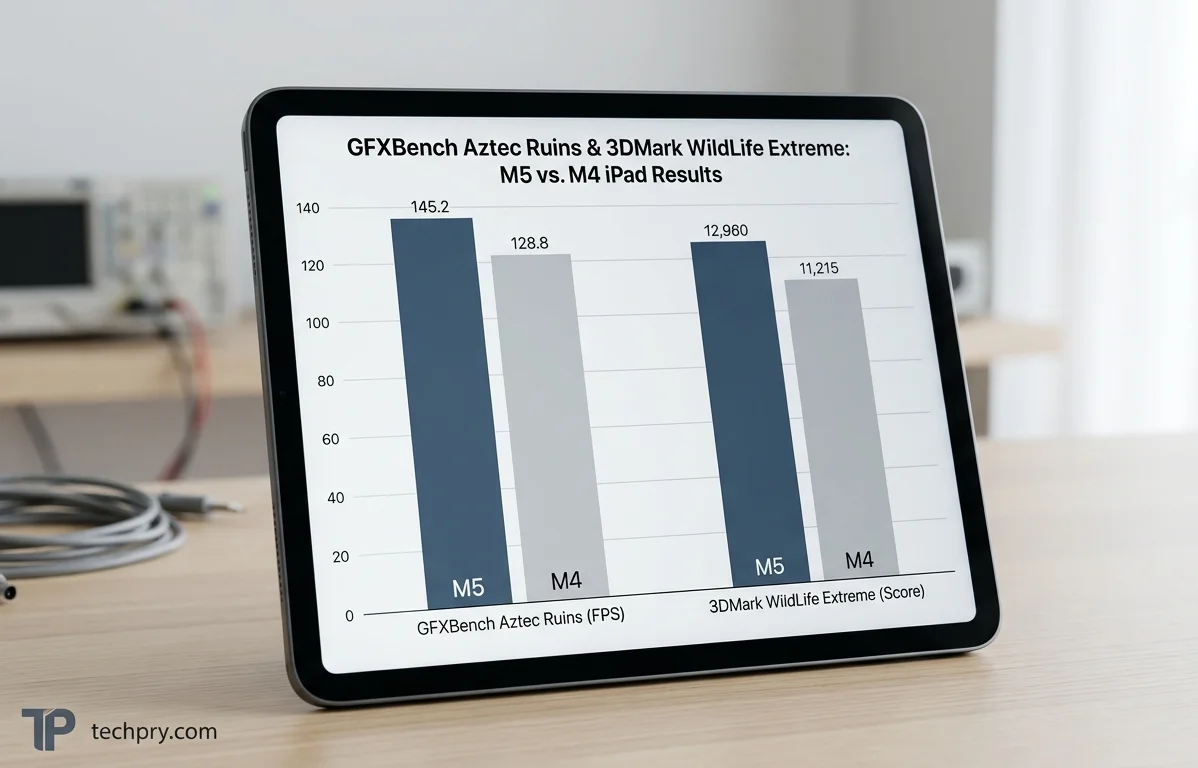
PCMag ran both iPads through Geekbench 6, Aztec Ruins (High Tier) and WildLife Extreme. The M5 wins every test, and the margin grows as the work moves from the CPU to the GPU. The last column below is worked out from PCMag's figures.
| Test | M5 iPad | M4 iPad | M5 ahead by |
|---|---|---|---|
| Geekbench 6 single-core | 4,141 | 3,679 | about 13% |
| Geekbench 6 multi-core | 15,490 | 14,647 | about 6% |
| GFXBench Aztec Ruins (High Tier) | 5,939 frames at 92.4 fps | 3,858 frames at 60 fps | about 54% |
| 3DMark WildLife Extreme | 10,929 at 65.4 fps | 8,597 total frames at 51.5 fps | about 27% |
The single-core gap of about 13 percent matches the figure one reviewer gives for the whole jump over the 2024 model, while multi-core is ahead by only about 6 percent. A CPU gain under 15 percent is usually hard to feel in ordinary apps, whereas a graphics gain of a quarter to a half shows up in games, rendering and other GPU-heavy work.
Is the M5 worth it over the 2024 iPad Pro or an M1 model?
It depends on what you own: a modest step from the 2024 M4 model, a large one from an M1 iPad Pro or older. The GoTranscript reviewer puts the gain over the previous year's model at about 13 percent, and says you will notice a much bigger difference coming from an M1 iPad Pro or older. Against the other current iPads, the same reviewer says the M5 iPad Pro is up to three times as fast.
Taken with PCMag's benchmark gaps, the pattern holds together: M4 owners get a CPU bump that is real but small, with the larger gains reserved for graphics-heavy and AI work, while an M1 iPad Pro sits several generations back, which is where the reviewer's bigger gap applies. The three-times figure is an ‘up to’ ceiling, and it compares the Pro with other iPad lines rather than with its own predecessors.
Apple's headline speed claims and what they leave out
Apple's headline multipliers come without a stated baseline, so they are not test results. PCMag's passage on what Apple emphasizes says the M5 is 1.5 times faster at ray-traced 3D rendering, and PCMag also lists video transcoding as 6 times faster; neither sentence says what the M5 is being compared with. The Verge, in its coverage of the new MacBook Pro and iPad Pro, goes no further than saying the M5 is supposedly faster than the M4, with better performance in graphically demanding applications.
The 1.5x figure, a 50 percent gain, falls inside the 27 to 54 percent range PCMag measured in its graphics tests, which makes it plausible against the M4, but without a baseline it cannot be matched to those runs. The 6x transcoding claim has no measured counterpart among the benchmarks reported for this chip, so it stays an unverified number.
Connectivity: the first tablet with Apple's C1X modem and N1 chip
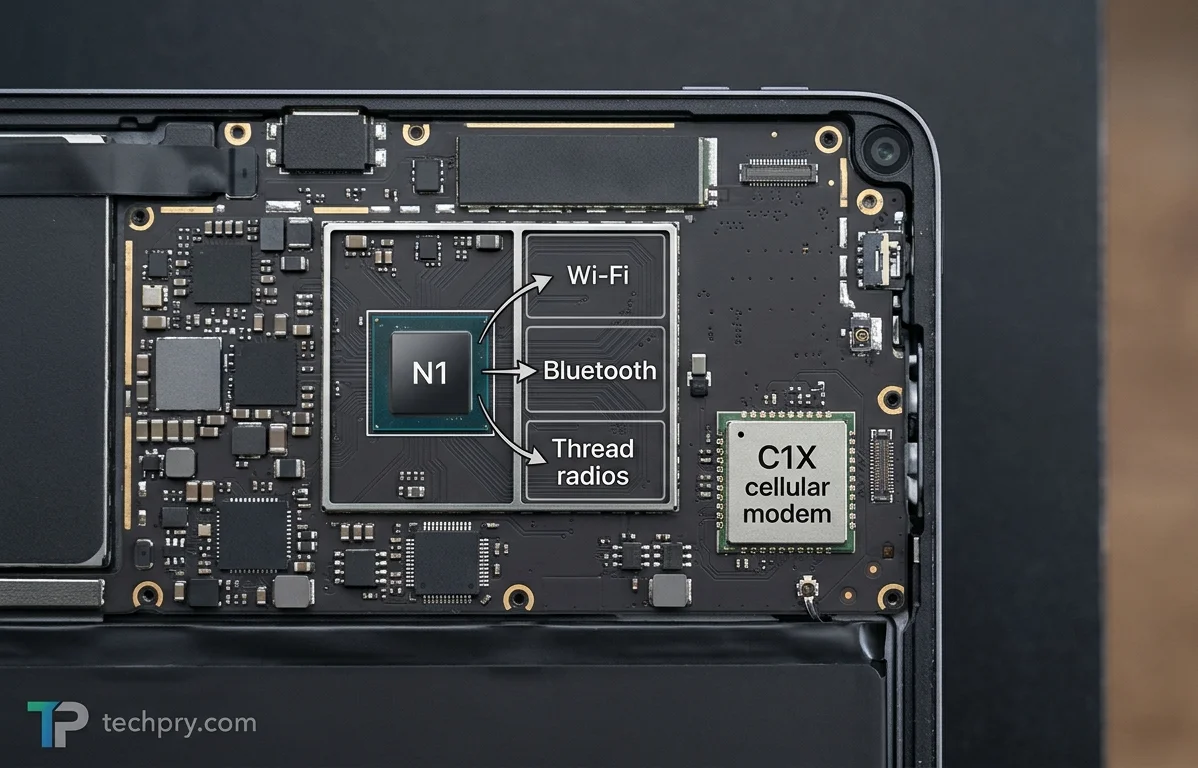
The M5 iPad Pro is the first tablet to use Apple's and , according to PCMag. The C1X handles cellular and the N1 handles Wi-Fi, Bluetooth and Thread, so both sides of the iPad's wireless setup now run on Apple's own parts; details follow below.
PCMag's connectivity section is headlined with the verdict that Apple's radios take the efficiency lead. Only one of the three reviews makes that call, and since both parts are new to tablets, it is an early read rather than a settled finding.
Cellular: what the C1X modem covers and what it skips
The M5 iPad Pro supports 5G and LTE through Apple's C1X modem, with sub-6 GHz 5G at 4x4 MIMO, LTE Cat. 24 and Gigabit LTE with 4x4 MIMO. The notable omission is : PCMag says the C1X runs sub-6GHz and but does not support it. mmWave is the very-high-frequency variety of 5G, so anyone who specifically wants that kind of coverage should look elsewhere.
On speed, PCMag adds that the C1X can lean on the M5's efficiency to double the theoretical peak speeds of C-band 5G. Theoretical is the operative word: it describes a ceiling that the network and signal must allow, not a typical download speed.
Wireless networking: what the N1 chip changes
The M5 iPad Pro's N1 chip combines the Bluetooth, Thread and Wi-Fi radios on a single chip and brings and . Wi-Fi 7 (802.11be) comes with 2x2 MIMO and simultaneous dual band, and the previous iPad Pro had Wi-Fi 6E and Bluetooth 5.3. , a low-power mesh protocol used by smart-home devices, is supported as well.
PCMag calls the move to Bluetooth 6.0 and Wi-Fi 7 welcome, and it is the only one of the three reviews to comment on the radios. The Wi-Fi 7 gain only materializes with a router that supports it, so for many home networks this is a future-proofing benefit rather than an instant speed-up.
Location: which satellite systems are listed, and on which models
The M5 spec lists GPS, GLONASS, Beidou, Galileo and QZSS. Apple's tech-specs page, however, lists GPS/ location only under the Wi-Fi + Cellular models, not in the line for all models. GNSS is the general term for satellite positioning, so a Wi-Fi-only buyer who relies on built-in location should confirm it before ordering.
AI hardware: 16 neural-engine cores plus an accelerator in each GPU core
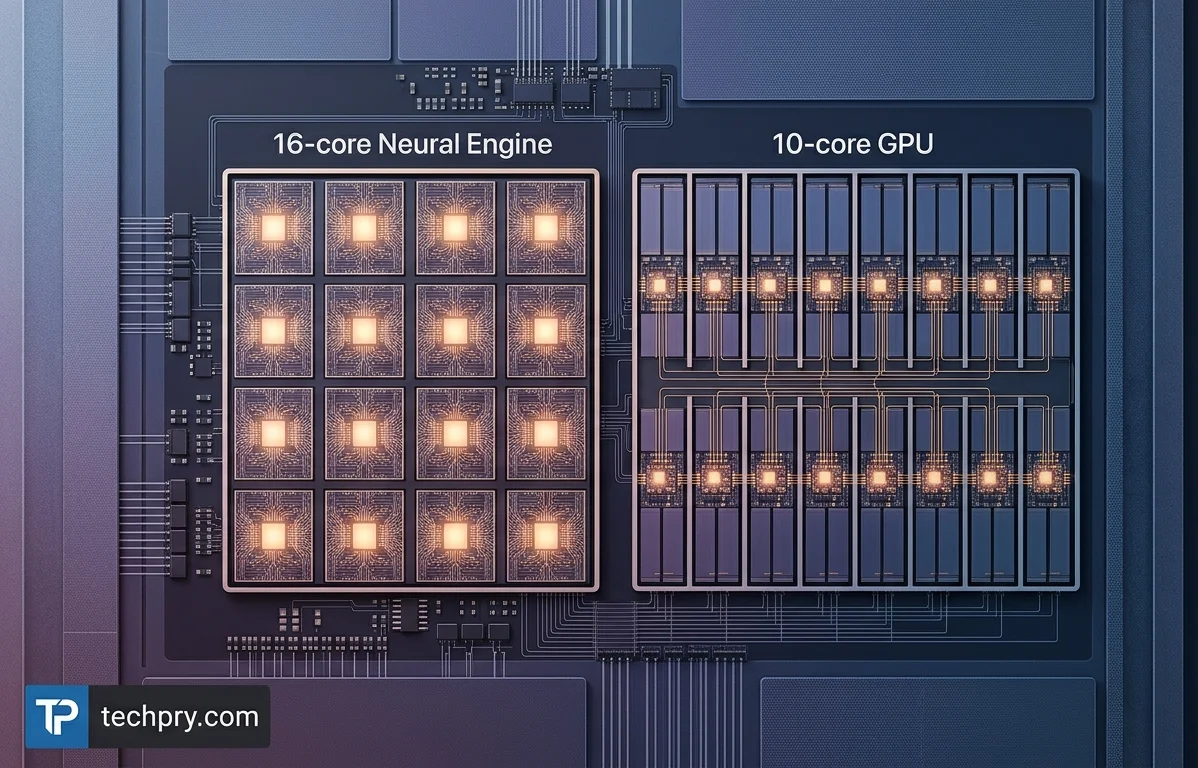
The M5 pairs the Apple , which has 16 cores, with built into each of the GPU's 10 cores. Its AI performance is described mostly through Apple's claims rather than test results, covered in the next subsection.
PCMag says the accelerators boost the GPU's ability to power AI tasks, and notes they are the same ones found in the iPhone 17's A19 chip, so they are not exclusive to the M5. ITPro gives handwriting recognition and AI voice translation as examples of on-device features the accelerators are meant to speed up.
ITPro is the one review that passes judgment here, calling it a big AI upgrade and pointing to the per-core accelerators as the reason. The hardware itself is not in doubt; what the reviews do not settle is how much faster everyday AI features run in practice.
Apple's claimed AI gains: 3.5 times faster than the M4
Every AI figure reported for the M5 is a claim, not a measurement. Apple claims the M5's AI performance is 3.5 times faster than the M4, as PCMag relays it. PCMag also lists AI image generation as 4 times faster and up to 3.7 times faster at , with no baseline stated for either.
Apple also says the M5 is significantly better at on-device , and The Verge relays Apple's line that the chip is significantly better at AI-based tasks generally. Apple says the Neural Engine is faster, while PCMag adds that the revised engine is more energy efficient than the M4's.
Set against the CPU results, the scale of the AI claims stands out: 3.5 times for AI against gains of 6 to 13 percent on the CPU. The two are not contradictory, since the AI figures describe workloads the accelerators and the revised engine are built for, but they cannot be compared with each other. Until an outlet runs an AI benchmark, the 3.5x remains Apple's number.
CPU: ten cores in a 4-plus-6 split, with a 9-core variant
The M5 has ten CPU cores: four performance cores at 4.61 GHz and six efficiency cores at 2.95 GHz. makes the chip on a 3 nanometer process, and it uses the instruction set.
| Item | Listed value |
|---|---|
| Cores | 10 (9 on 256GB and 512GB models) |
| Performance cores | 4 at 4.61 GHz |
| Efficiency cores | 6 at 2.95 GHz |
| Peak frequency | 4610 MHz |
| L1 cache | 192 KB |
| L2 cache | 16 MB |
| Process and maker | 3 nm, TSMC |
| Instruction set | ARMv9.2-A |
The 10-core part is not the only one. Models with 256GB or 512GB of storage use a 9-core version with 3 performance and 6 efficiency cores, and ITPro and PCMag both describe the chip as a 9- or 10-core design. The tier table in the memory section shows how that lines up with RAM.
The missing performance core may explain some score differences between outlets. ITPro's multi-core Geekbench 6 result is about 8 percent above PCMag's (16777 against 15490), while the single-core scores sit within about 1 percent of each other (4193 and 4141). That pattern would fit a one-core difference between configurations, though ordinary run-to-run variation could produce it too, and neither review confirms which variant it tested.
GPU: 10 cores at 1620 MHz with 1,280 shaders
The Apple M5 GPU has 10 cores running at 1620 MHz, with 1280 shaders in total and hardware-accelerated . The spec calls the cores pipelines and lists 128 shading units, which fits 128 per core across the 10 cores, on what it names the Apple GPU architecture.
The spec also lists 4147.2 Gigaflops. Arithmetic on the listed shader count and clock reproduces that exactly when each shader is counted at two operations per cycle, so it reads as a theoretical peak rather than a measured result. The measured evidence for the GPU is PCMag's graphics benchmarks above, and the accelerator in every core is covered in the AI section.
Synthetic graphics scores listed for the M5
The M5's listed 3DMark results are 4104 in and 17310 in , plus PCMag's separate WildLife Extreme run.
- Steel Nomad Light: score 4104, 71% stability, graphics test at 30 FPS
- Solar Bay: score 17310, graphics test at 66 FPS
- Section 1, 2 and 3 results: 88, 63 and 46 FPS, listed without naming the test they belong to
- WildLife Extreme in PCMag's run: 10,929 at 65.4 fps
These scores come from different tests and cannot be compared with one another. Only WildLife Extreme has an M4 counterpart (8,597), so the other figures gain meaning only when set against other devices' runs. If the 71 percent stability value follows 3DMark's usual meaning, it suggests performance eased off across repeated loops under sustained load, though the listing does not say how the run was made.
Memory and bandwidth: what changed from the M4
The M5 uses memory at 4800 MHz on an 8x16-bit bus. Maximum bandwidth is listed as 153 Gb/s in the spec and 153Gbps by PCMag, up from the M4's 120Gbps.
The unit needs a flag. Apple's tech-specs page writes the same number as 153GB/s, gigabytes rather than gigabits, which is a factor of eight apart. The bus figures favor the gigabytes reading: eight 16-bit channels at 4800 MHz move far more than 153 gigabits per second, so if the spec's bus and clock are right, GB/s is the more plausible unit. Either way, the jump from 120 to 153 is about 28 percent whenever both numbers share a unit, which is how PCMag states them. A rise of that size matters most to graphics and AI work, which is where the measured and claimed gains are largest.
RAM by storage tier, and how fast the storage is
RAM depends on the storage you buy: 12GB on the 256GB and 512GB models and 16GB on the 1TB and 2TB ones. Storage is , and PCMag credits quicker RAM and storage with a 2x faster read and write speed, which it ties to faster AI performance.
| Storage tier | CPU | RAM | Against the M4 iPad Pro |
|---|---|---|---|
| 256GB or 512GB | 9-core (3 performance, 6 efficiency) | 12GB | up from 8GB |
| 1TB or 2TB | 10-core (4 performance, 6 efficiency) | 16GB | unchanged at 16GB |
The biggest RAM change lands on the cheaper tiers, while the 1TB and 2TB buyers are the ones who get the 10-core chip and 16GB. Paying for the higher storage therefore also buys one more performance core and 4GB more RAM, a trade a 256GB buyer with heavy multitasking or AI workloads should weigh.
One spec conflict sits here. The spec lists a 24 GB maximum memory size, while ITPro says up to 16GB, which is also the highest figure on Apple's page. A chip's listed ceiling can sit above what a given device offers, which would reconcile the two, though the sources do not say so.
Media engine, codecs and maximum display resolution
The M5's media engine accelerates H.264, HEVC, and ProRes RAW in hardware, with separate video decode, video encode and ProRes encode and decode engines, and it supports decode. The spec lists H.264, H.265, AV1 and VP9 video codecs and AAC, AIFF, CAF, MP3, MP4 and WAV audio codecs, with 4K at 60FPS for both capture and playback. Apple's page words the capture side as 4K recording at 24, 25, 30 or 60 fps.
Two details are easy to miss. AV1 is listed as decode only, so the chip plays that format in hardware, but the listing shows no hardware AV1 encoding. VP9 appears in the spec's codec list but not among the hardware-accelerated formats, and neither list says how it is handled. For video editors, the ProRes and ProRes RAW acceleration with dedicated engines is the practical highlight.
On display output, the spec's maximum display resolution is 2752 x 2064, whereas PCMag gives the 13-inch model's resolution as 2,732 by 2,048. The two may not measure the same thing, since a chip-level ceiling can sit slightly above the native resolution of the panel it drives.
When was the M5 announced, and what is its model number?
The M5 was announced in October 2025 under the model number T8142, and the spec classes it as a flagship. ITPro likewise calls it the most powerful flagship processor in the iPad Pro.
The chip arrived in late 2025 alongside a new iPad Pro, and , and ITPro's view is that the launch was really about the M5 itself. The Verge adds that the late-2025 MacBook Pro and iPad Pro models each carry their own upgrades beyond the chip, which fits the radios, RAM and storage changes described above.
Who the M5 iPad Pro suits and who can skip it
The answer splits by what you own now and which configuration you would buy.
- Owners of an M1 iPad Pro or older: the reviewer says you will notice a way bigger difference, with up to three times the speed of other current iPads.
- Owners of the 2024 M4 model: the CPU gain is about 13 percent at best in PCMag's runs and graphics is the stronger case, so unless you do GPU-heavy work or want the new radios there is little pressure to move.
- Buyers choosing a storage tier: 256GB and 512GB models get 12GB of RAM and a 9-core CPU, while 1TB and 2TB models get 16GB and 10 cores.
- Cellular buyers: the modem covers sub-6GHz and C-band 5G but not mmWave.
- Anyone buying for on-device AI: the hardware is there, but the multipliers are Apple's claims, so decide on what you need today.
Comments 0
Please log in or sign up to comment.