
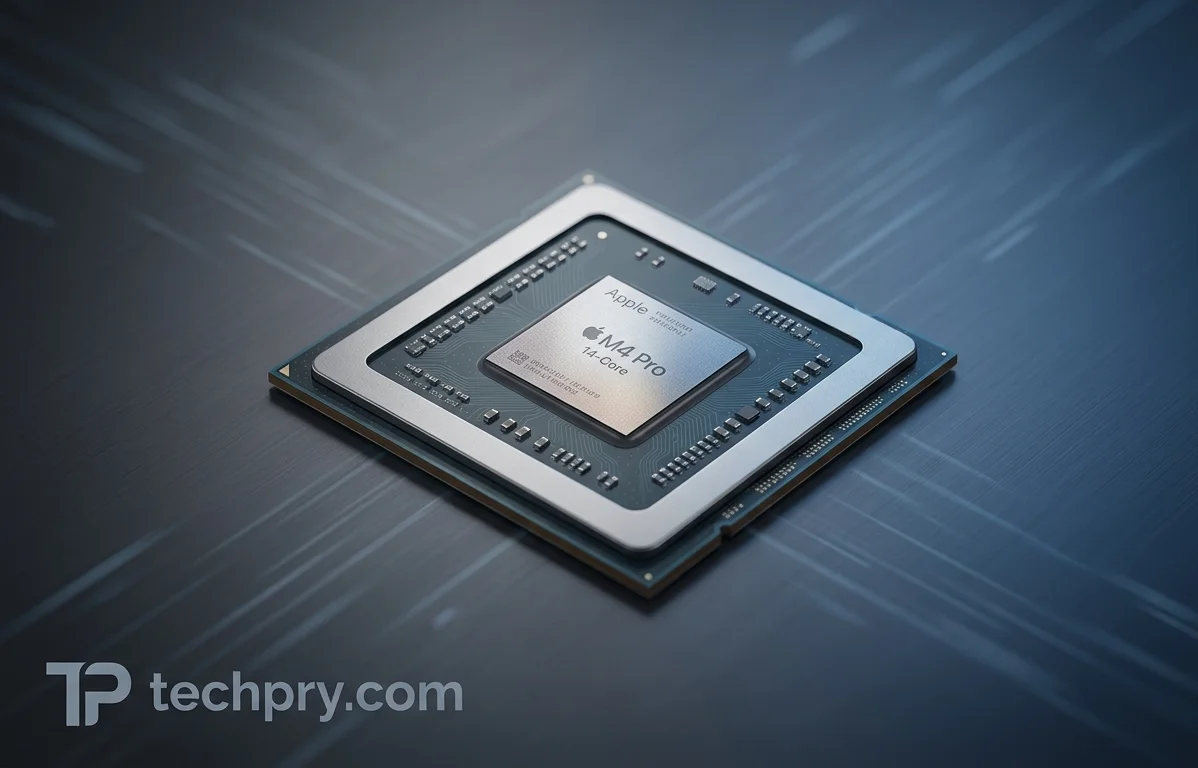
Apple M4 Pro 14-Core: About 1% Behind the 14-Core M4 Max on CPU Score
PassMark puts it only 1.1% behind the 14-core M4 Max, so a clear CPU step up starts at the 16-core Max, while memory tops out at 64 GB without ECC.
Contents
- Reviewer verdict: a powerful chip for people who need more from their laptop
- Core layout: 14 cores, 14 threads, 10 performance and 4 efficiency
- Clock speeds: 4.51 GHz and 2.59 GHz base, and what a reviewer saw under load
- Cache and clock multiplier: 192K L1 per core, 32MB shared L2, locked 45x
- PassMark standing: 73rd for single thread, 410th for multi-thread, average score 37,937
- Sub-test results: where the score comes from
- Multi-core comparison: ahead of the Ryzen AI 9 HX 370 and Core Ultra 9 285H, behind the 16-core M4 Max
- Recent baseline runs: from 24,933 to 38,495
- Integrated GPU: 20 cores, 2,560 shading units and 8.1 TFLOPS
- Memory: LPDDR5X-8533, up to 64 GB at 273 GB/s, 24GB base
- Is it laptop-only? What the spec and PassMark say, and where the 14-core chip ships
- Who makes it, when it arrived and what replaces it
- Ray tracing, machine-learning hardware and video codec support
- Power and package: 3 nm, 46 W TDP, Apple M-Socket, 100°C peak
- Who should buy it, and who should look elsewhere
The figure that frames the 14-core M4 Pro best is a gap rather than a score: PassMark has the 14-core M4 Max only 1.1% ahead of it, while the 16-core M4 Max is 15.6% ahead. Inside Apple's lineup, that makes the CPU step up a question of core count more than of the Pro-versus-Max label. Reviewers treat the chip as the powerful option for people who need more from their work, and the spec sheet backs that with ten performance cores, a 20-core GPU and room for up to 64 GB of memory.
Reviewer verdict: a powerful chip for people who need more from their laptop
LaptopMedia and Notebookcheck both describe the M4 Pro as powerful, so the two reviews agree on that point. LaptopMedia ties it to positioning: with its beefy SoC, the Pro model is meant for users who need more power for their work, while Notebookcheck simply lists a powerful processor among its positives.
Only one of the two goes further on how much the chip has improved. Excerpts on Notebookcheck's page say the M4 Pro is faster again than what came before and a major leap in nearly every performance measure, naming the CPU, GPU and neural-processing hardware. The Verge, quoted there, calls the M4 Pro the logical choice for more demanding professionals, adding that it is where the 16-inch screen option comes in for people who want a larger display.
These are endorsements without a number attached. Nothing in them says how much faster the chip is than its predecessor, so PassMark's figures below are the only way to put a measurement on the claim, and they show where the chip stands rather than how far it has moved.
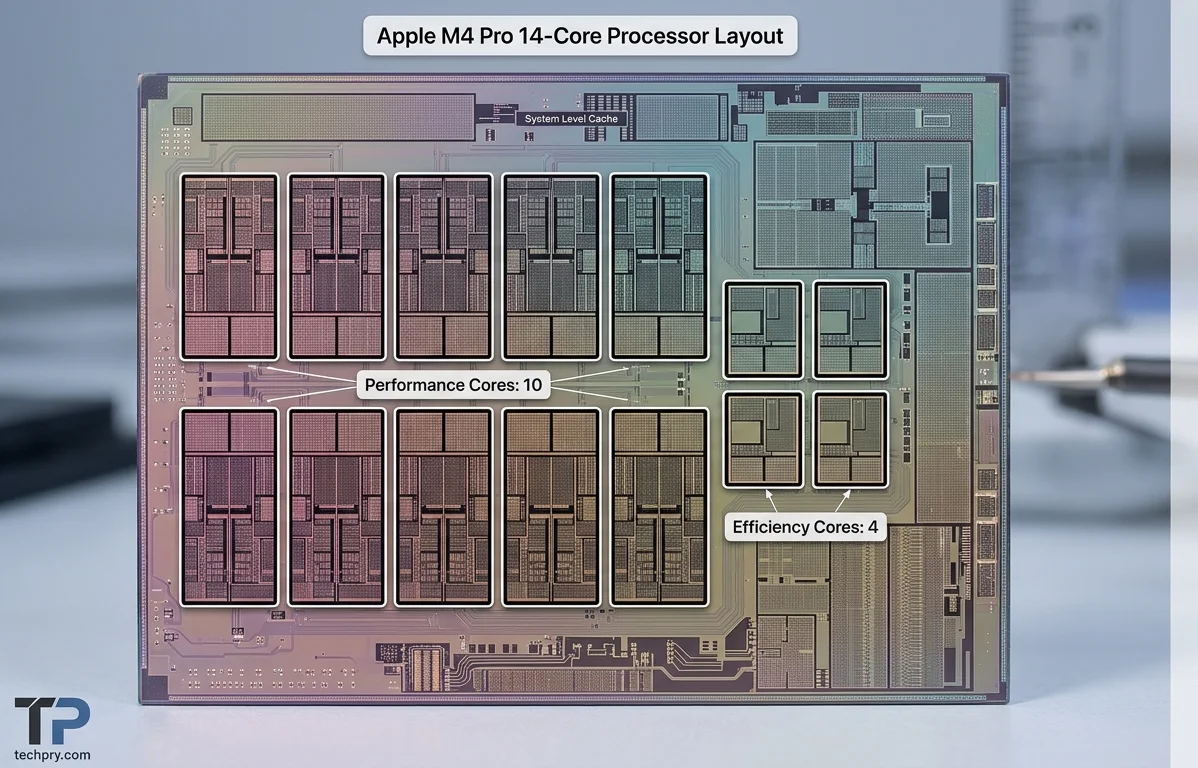
Core layout: 14 cores, 14 threads, 10 performance and 4 efficiency
The 14-core M4 Pro has 14 cores and 14 threads in total: 10 performance cores running 10 threads and 4 running 4 threads. Apple Support and PassMark both list the same 10/4 split. Because the thread count matches the core count at every level, each core runs a single thread.
The layout is easier to judge next to the smaller option. Apple also offers a , which Apple Support lists as 8 performance cores plus the same 4 efficiency cores, and LaptopMedia says the 12-core and 14-core versions come with a 16-core and a 20-core GPU respectively. Moving up to 14 cores therefore adds two performance cores and four GPU cores while the efficiency cluster stays the same, so the choice really comes down to how much multi-core power the work calls for.
Clock speeds: 4.51 GHz and 2.59 GHz base, and what a reviewer saw under load
The spec lists a base frequency of 4.51 GHz for the performance cores and 2.59 GHz for the efficiency cores, and PassMark rounds these to 4.5 GHz and 2.6 GHz. A LaptopMedia review excerpt on Notebookcheck's page praises the CPU for holding clocks of 3.92 GHz and 2.59 GHz no matter the load.
The efficiency-core figure of 2.59 GHz matches the spec exactly. The performance-core figures differ, but they measure different things: 4.51 GHz is a base frequency, while 3.92 GHz is a sustained clock under load. The takeaway is the reviewer's point that the clocks stay put instead of sagging as the load rises. It is one review's observation (one of the two), and the excerpt calls the chip the M4 CPU on a page about the M4 Pro model, so treat it as an indication rather than a measured spec for the 14-core part.
Cache and clock multiplier: 192K L1 per core, 32MB shared L2, locked 45x
Each core has 192K of L1 cache, and the chip shares a 32MB . The bus frequency is 100 MHz and the multiplier is 45x. Multiplied together they give 4.5 GHz, which lines up with the performance cores' listed base frequency. The multiplier is not unlocked, so this is not a chip to overclock.
PassMark standing: 73rd for single thread, 410th for multi-thread, average score 37,937
PassMark's CPU benchmark charts rank the chip 73rd fastest in single threading and 410th in multithreading out of 6,059 CPUs, with an average of 37,937. Split by class, it is 37th of 1,652 laptop CPUs and 108th of 1,595 desktop CPUs. These are PassMark's own figures, not reviewer claims.
The gap between the two overall ranks is the useful part. Placing 73rd on single thread but 410th on multi-thread says the chip's standing rests more on the speed of each core than on how many threads it can run in parallel, and for heavily parallel work the chips higher in the comparison below pull ahead. For a buyer, the laptop ranking is the one that counts, since that is the class the spec assigns it, while the desktop placement shows it also holds its own against desktop chips.
Sub-test results: where the score comes from
PassMark breaks the score into individual tests, listed here as reported.
| Test | PassMark result |
|---|---|
| Single Thread | 4,544 MOps/Sec |
| Integer Math | 83,957 MOps/Sec |
| Floating Point Math | 85,454 MOps/Sec |
| Find Prime Numbers | 530 Million Primes/Sec |
| Random String Sorting | 54,838 Thousand Strings/Sec |
| Data Encryption | 23,026 MBytes/Sec |
| Data Compression | 486,963 KBytes/Sec |
| Physics | 5,313 Frames/Sec |
| Extended Instructions | 25,671 Million Matrices/Sec |
Integer and floating-point math come out nearly level, so there is no obvious weak side in basic math throughput. The units differ from test to test, which means the rows cannot be compared with each other; they only become meaningful against other chips' results in the same tests.
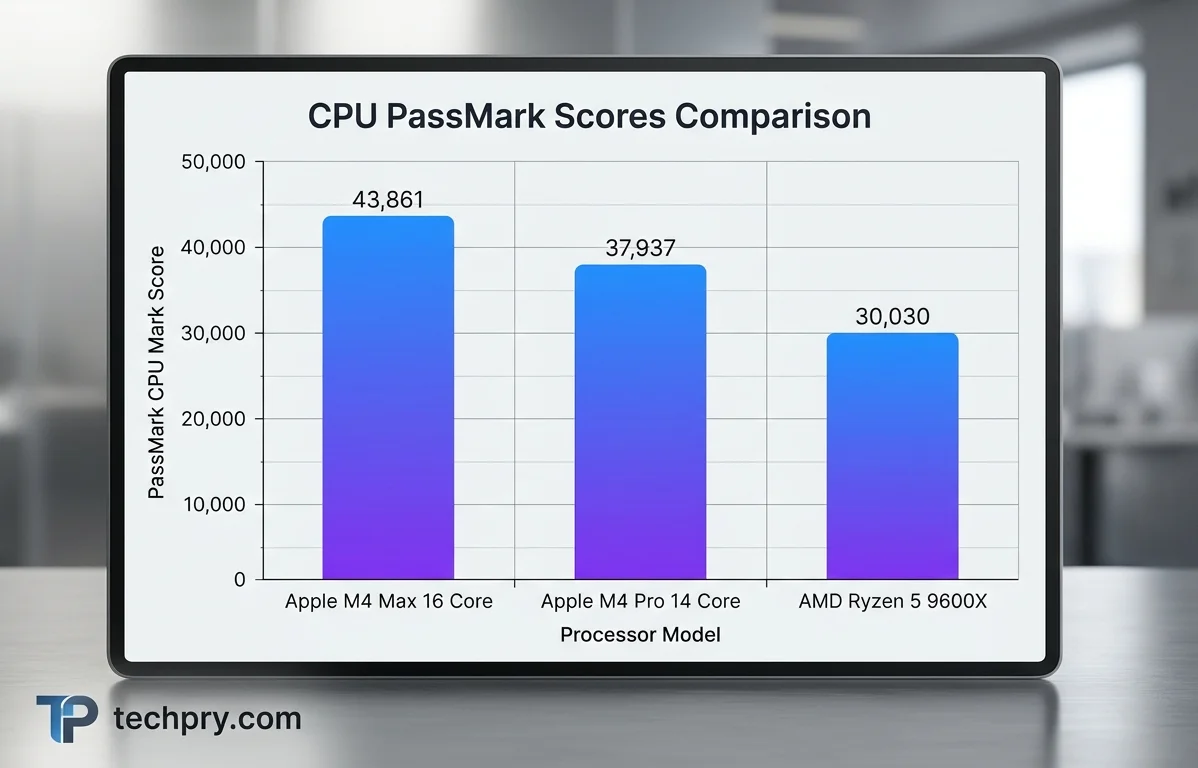
Multi-core comparison: ahead of the Ryzen AI 9 HX 370 and Core Ultra 9 285H, behind the 16-core M4 Max
In PassMark's comparisons, the lands 7.9% below the M4 Pro and the 9.8% below it, while the sits 15.6% above and the 13.3% above. The full set, sorted by score, looks like this.
| Chip | CPU Mark | Versus M4 Pro 14 Core |
|---|---|---|
| Apple M4 Max 16 Core | 43,861 | +15.6% |
| Intel Core Ultra 5 245K | 42,995 | +13.3% |
| Intel Core i5-14600K | 38,351 | +1.1% |
| Apple M4 Max 14 Core | 38,348 | +1.1% |
| Intel Core i5-14600KF | 38,218 | +0.7% |
| Apple M4 Pro 14 Core | 37,937 | reference |
| AMD Ryzen AI 9 HX 375 | 35,444 | -6.6% |
| AMD Ryzen AI 9 HX 370 | 34,945 | -7.9% |
| Intel Core Ultra 9 285H | 34,218 | -9.8% |
| Intel Core Ultra 7 265H | 33,953 | -10.5% |
| Intel Core Ultra 5 225 | 30,331 | -20.0% |
| AMD Ryzen 5 9600X | 30,030 | -20.8% |
Three results sit within about one percent of the M4 Pro: the 14-core M4 Max, the Core i5-14600K and the Core i5-14600KF. The first of those is the telling one, because choosing a 14-core Max over the 14-core Pro would change the CPU score by only about 1%, and the step that matters is the 16-core Max. The Core Ultra 5 225 and Ryzen 5 9600X trail by about a fifth. This comparison covers CPU score only and says nothing about GPU or memory.
Recent baseline runs: from 24,933 to 38,495
PassMark lists five recent baseline runs, and individual results range widely around the 37,937 average.
| Run date | CPU Mark |
|---|---|
| Oct 10 2026 | 38,495 |
| Oct 11 2026 | 32,864 |
| Oct 13 2026 | 24,933 |
| Oct 17 2026 | 38,027 |
| Oct 21 2026 | 37,621 |
Three of the five land close to the average, while the runs of Oct 11 2026 and Oct 13 2026 fall well short. Nothing in the listing explains the dips, and a single low submission such as the 24,933 run says little about the chip itself, which is why the average is the better figure to quote. The dips also sit uneasily with LaptopMedia's description of clocks that hold steady under any load, although a baseline run gives no information about the conditions behind it.
Integrated GPU: 20 cores, 2,560 shading units and 8.1 TFLOPS
The integrated GPU is the with 20 cores, a figure the spec, LaptopMedia, Apple Support and PassMark all give, and LaptopMedia pairs it with the 14-core CPU, as the 12-core version gets 16 GPU cores. The rest of the spec reads as follows.
| GPU spec | Value |
|---|---|
| Base clock | 500 MHz |
| Boost clock | 1578 MHz |
| Shading units | 2560 |
| TMUs | 160 |
| ROPs | 80 |
| Execution units | 320 |
| TGP | 26 W |
| Compute | 8.1 TFLOPS |
The headline number holds up on paper: 2,560 shading units at the 1578 MHz boost clock, at two operations per unit per cycle, works out to roughly 8.1 TFLOPS. That is a theoretical peak at boost clock, and the gap between the 500 MHz base and the 1578 MHz boost shows how much the GPU's speed can vary with demand.
Memory: LPDDR5X-8533, up to 64 GB at 273 GB/s, 24GB base
The M4 Pro uses LPDDR5X-8533 memory, tops out at 64 GB with a maximum bandwidth of 273 GB/s, and starts at a base configuration of 24GB of . Apple Support lists the same 273GB/s figure, and LaptopMedia, Apple Support and Notebookcheck all give 24GB as the base. The spec also lists 16 memory channels.
Unified memory means the CPU and the 20-core GPU draw on one pool, so the 24GB base, and the 64 GB ceiling above it, is shared between them. The other limit is that is not supported, which rules the chip out for buyers whose work requires error-correcting memory.
Is it laptop-only? What the spec and PassMark say, and where the 14-core chip ships
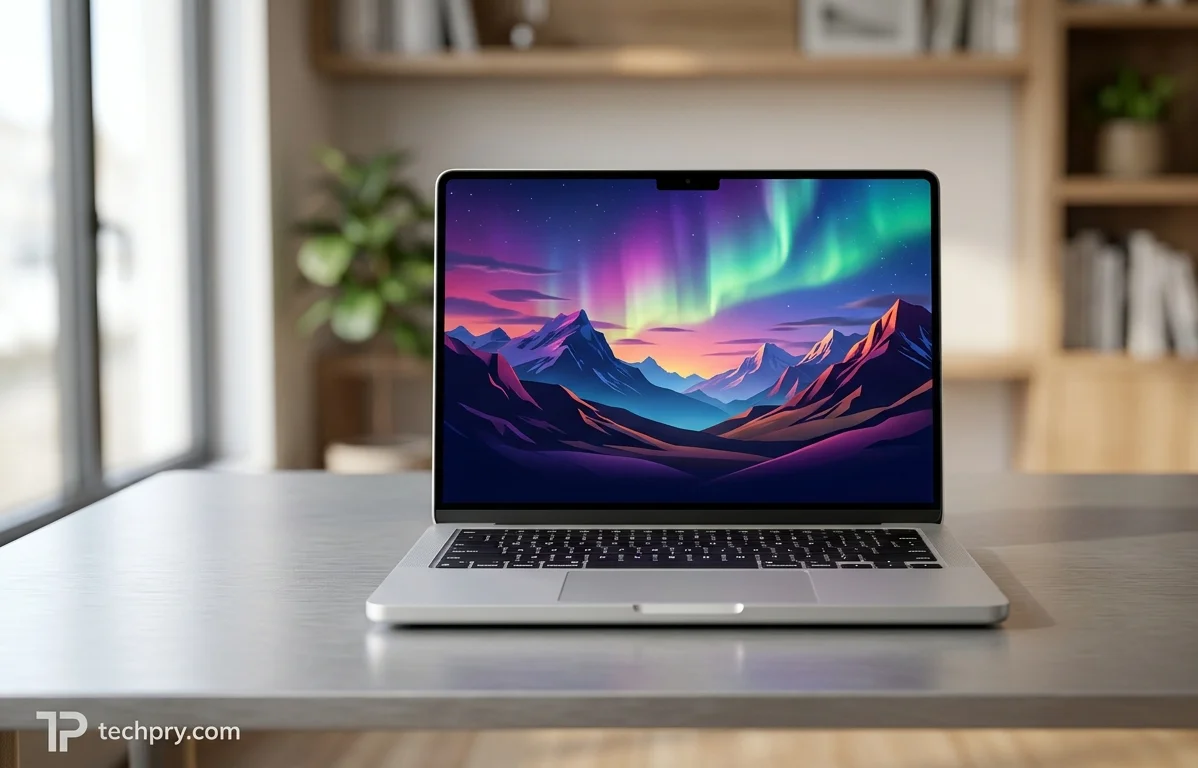
Not strictly: the spec lists the type as laptop, but PassMark classes the chip as both desktop and laptop, a difference from the spec. In practice the 14-core M4 Pro is a MacBook Pro chip. Apple Support's page for the 14-inch MacBook Pro lists the M4 Pro with a 14-core CPU and 20-core GPU, and LaptopMedia's review of that machine says the same.
Larger-screen buyers are covered as well: The Verge, quoted on Notebookcheck's page, says the with the M4 Pro comes with a 14-core CPU. The laptop-versus-desktop label therefore matters less to a buyer than the fact that both MacBook Pro sizes are the route to this 14-core configuration.
Who makes it, when it arrived and what replaces it
Apple makes the chip, which was released on October 29, 2024, uses the instruction set and lists the as its successor. PassMark first saw it on its charts in Q4 2024. The spec lists the codename as Apple M4 and the model number as T6040, and the model number is the more specific label when searching for this exact part.
A successor is already listed, so for anyone shopping now the 14-core M4 Pro is a previous-generation part. No benchmark figures for the successor are included here, so this article cannot place the two against each other.
Ray tracing, machine-learning hardware and video codec support
Apple's tech specs list the M4 Pro with hardware-accelerated ray tracing, a 16-core and a media engine that accelerates H.264, HEVC, and ProRes RAW in hardware. The media engine has a single video decode engine, a single video encode engine and a single ProRes encode and decode engine. It also supports AV1 decode.
AV1 appears only on the decode side of the listing, while hardware encoding is listed for H.264, HEVC and ProRes. For video work, that means playback of AV1 files is accelerated in hardware, but exporting in that format is not listed as hardware-assisted.
Power and package: 3 nm, 46 W TDP, Apple M-Socket, 100°C peak
The chip is built on a with a 46 W TDP (PL1), uses the Apple M-Socket and has a peak temperature of 100°C. PL1 is the long-term power level, so 46 W is the sustained budget the spec assigns, and it sits alongside the reviewer's observation that clocks hold steady under load. Neither the spec nor that review says how much the laptop's cooling contributes, so the steadiness cannot be credited to the chip alone. The 100°C figure is a peak temperature, so it describes a limit rather than what the chip normally runs at.
Who should buy it, and who should look elsewhere
The 14-core M4 Pro suits people whose work keeps the processor busy and who want that power in a laptop: both reviews call it powerful, The Verge pitches it at demanding professionals, and PassMark places it 37th among 1,652 laptop CPUs. A 24GB base memory, a 20-core GPU rated at 8.1 TFLOPS and hardware ProRes support add up to a sensible fit for video and graphics work, though these are specifications rather than workload results.
Look elsewhere if the work needs ECC memory, which is not supported, or more than the 64 GB ceiling. The same goes for anyone chasing the most CPU throughput in Apple's range: the 16-core Max scores 15.6% higher, while the 14-core Max is only 1.1% ahead and changes little for CPU-bound work. Buyers who want the newest silicon should also check the listed successor, the 18-core M5 Pro, before committing.
Comments 0
Please log in or sign up to comment.