
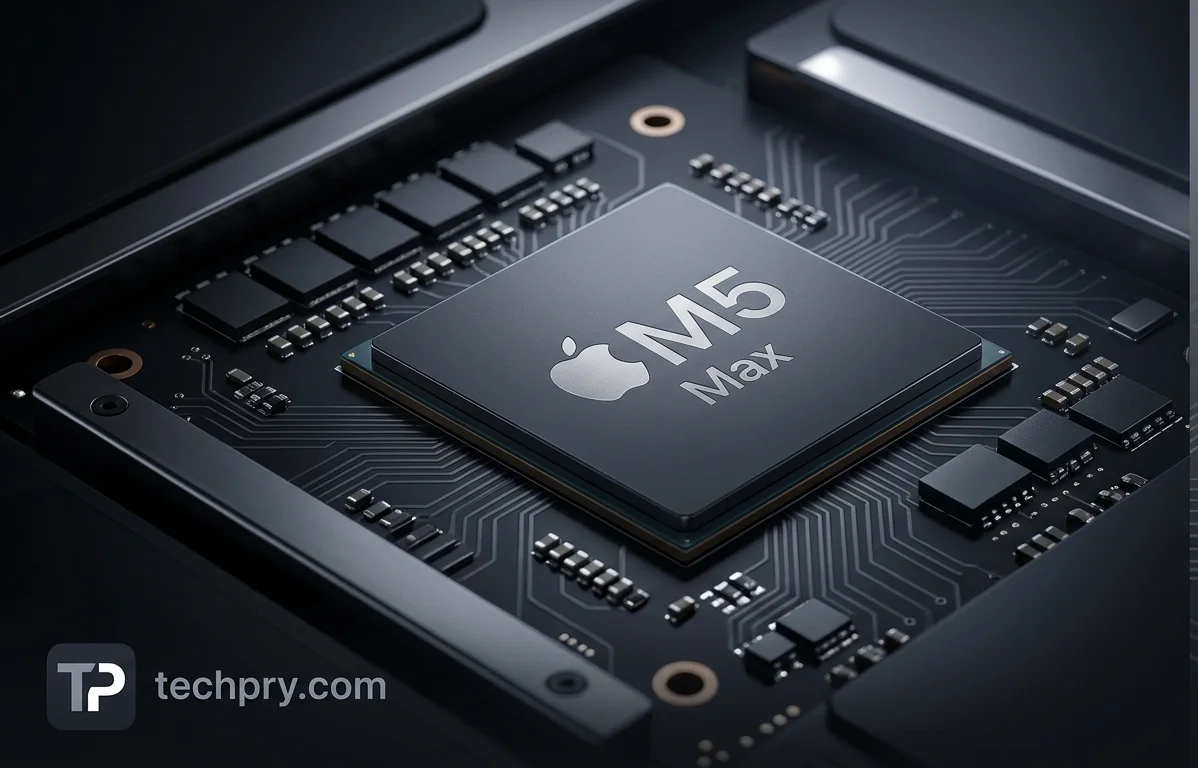
Apple M5 Max 40-Core GPU: A Memory-First Case for Local AI, With Estimated Compute Gains
The 40-core M5 Max GPU's draw is how much memory it can reach, while its roughly 70 TFLOPS FP16 figure is an estimate from Apple's specs and NVIDIA keeps a wide lead in raw compute.
Contents
- Is the 40-core M5 Max GPU suited to local large-model AI inference?
- Memory: up to 128 GB of shared memory at 614 GB/s on a 512-bit bus
- Compute throughput: 16.6 TFLOPS FP32 and an estimated ~70 TFLOPS FP16 versus the M4 Max
- How does it stack up against NVIDIA and other competing GPUs?
- Benchmark scores: 3DMark and Geekbench results
- OpenCL results: image processing and particle physics
- Machine-learning scores: from text classification to pose estimation
- Gaming performance: four titles from laptop reviews
- What it is: an integrated laptop GPU in the M5 Max, released March 3, 2026
- How many cores does it have, and how fast do they run?
- Ray tracing, upscaling and API support
- Manufacturing process, transistor count, power draw and thermal limit
- Who it suits, and who should skip it
What sets the 40-core M5 Max GPU apart is how much memory it can reach, not how fast it computes. The GPU can address up to 128 GB of shared memory, depending on configuration , and Skorppio's analysis argues that this could eliminate the video-memory cliff that hobbles NVIDIA cards on models of 70B parameters and up, even as it concedes that NVIDIA still dominates raw compute . The headline AI figure, roughly 70 TFLOPS of FP16, is an estimate from Apple's published specifications rather than a measurement , so a buyer is weighing a strong capacity argument against compute gains that are still projections .
Is the 40-core M5 Max GPU suited to local large-model AI inference?
The 40-core M5 Max GPU looks well suited to large-model AI work on a single machine, mainly because of its memory, but that verdict is conditional on Apple's specifications holding up under real-world testing . The GPU can reach up to 128 GB of , depending on configuration , and Skorppio stresses that all of it is GPU-addressable and available to AI workloads without memory copies . Its argument is that this could eliminate the VRAM cliff that hobbles NVIDIA cards on 70B+ models, the point where a model no longer fits in dedicated memory, making one M5 Max machine the strongest option for large-model .
Skorppio frames the chip as Apple's most serious bid yet to challenge NVIDIA in and local inference, not in datacenter training . The same analysis lists what NVIDIA keeps: raw compute (5–28× more TFLOPS), small-model speed and training at scale . Put together, the positives are all about capacity and the negatives are all about speed. A buyer whose obstacle is fitting a 70B-class model on one machine sits on the favorable side of that split, while someone who needs fast small-model runs or training sits on the other . The evidence behind this reading is a single analysis built on Apple's published specifications, so it is a well-argued projection rather than a verified result .
Memory: up to 128 GB of shared memory at 614 GB/s on a 512-bit bus
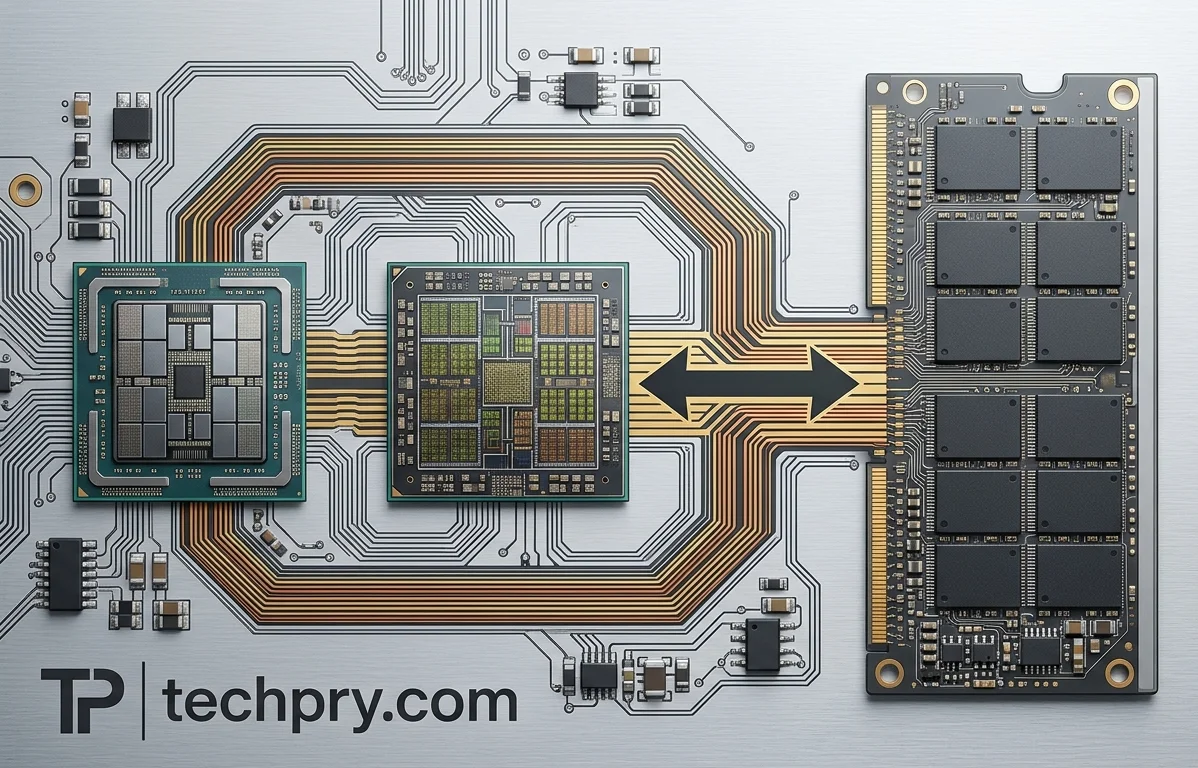
The GPU has no dedicated VRAM: it uses system-shared memory, up to 128 GB depending on configuration, over a 512-bit bus with 614 GB/s of bandwidth and no . Capacity decides whether a large model loads at all, and bandwidth is one of the things that then shapes how quickly it runs, so those two figures carry the AI case described above . The missing error correction is a footnote for most buyers and a disqualifier only for those whose workflow requires ECC memory .
One figure is contested. The listed memory clock is 9600 MHz , but Notebookcheck reports a memory speed of 8533 MHz and names the type as , written LPDDR5x-8533 . The memory family is not in dispute; the speed grade attached to it is. The 9600 MHz figure squares better with the other numbers: a 512-bit bus delivering 614 GB/s implies an effective rate of 9600 MHz, while 8533 MHz on the same bus would give lower bandwidth . Notebookcheck's own page lists the 614 GB/s figure too , which makes its 8533 MHz entry look like the outlier, and 9600 MHz the more plausible clock.
Compute throughput: 16.6 TFLOPS FP32 and an estimated ~70 TFLOPS FP16 versus the M4 Max
The GPU is rated at 16.6 TFLOPS of FP32 compute , and Skorppio estimates about 70 TFLOPS of FP16 from Apple's published specifications, citing 1,024 fused multiply-accumulate operations per core per cycle . Against the , its predecessor , that would be a potential 4× leap in over the older GPU's 18.4 TFLOPS, which Skorppio says came through shared ALUs .
The gain is credited to new hardware. The GPU carries , dedicated matrix-multiplication hardware that Notebookcheck describes as tensor cores, and both Skorppio and Notebookcheck present it as new for Apple GPUs .
Two cautions follow. The FP32 rating and the FP16 estimate describe different paths: the fourfold gain is credited to the matrix hardware, so it should show up in AI workloads that can use that hardware, not in everything the GPU does . And Skorppio treats the gain as potential only, contingent on real-world testing . The Geekbench ML scores later in this article are measured numbers, but they cover individual workloads rather than a TFLOPS ceiling, so they neither confirm nor refute the 70 TFLOPS estimate .
How does it stack up against NVIDIA and other competing GPUs?
Skorppio says NVIDIA still dominates raw compute, with 5–28× more TFLOPS, as well as small-model speed and training at scale . Notebookcheck, by contrast, describes the GPU as a fairly fast integrated graphics card and carries an analysis headline that puts it on par with the and faster than .
Both views can stand, because the headline gives no metric or test conditions and so cannot be set against Skorppio's TFLOPS ratio . What the pair tells a buyer is where the question sits. If the job is fast AI compute, Skorppio's ratio says NVIDIA leads by a wide margin, and the M5 Max pitch is capacity instead . If the job is graphics, the headline suggests the GPU holds its own, though without a stated metric to check . The mid-range segment tag in the catalogue is best read as a classification rather than a performance claim.
Benchmark scores: 3DMark and Geekbench results
NanoReview lists a score of 79229 and a score of 42463 for the GPU . On their own, the two numbers say little about whether that is fast or slow; they are reference points for lining the GPU up against other chips in the same tests . NanoReview's Geekbench 6 results, split into compute and machine-learning tests, follow below.
OpenCL results: image processing and particle physics
NanoReview's listing covers eight workloads, each reported in its own unit .
| Workload | Result |
|---|---|
| Background Blur | 257 img/sec |
| Face Detection | 182.1 img/sec |
| Horizon Detection | 5.4 Gpixels/sec |
| Edge Detection | 8.33 Gpixels/sec |
| Gaussian Blur | 8.86 Gpixels/sec |
| Feature Matching | 1.28 Gpixels/sec |
| Stereo Matching | 455.4 Gpixels/sec |
| Particle Physics | 21658 FPS |
Rows in different units cannot be compared, and even among the Gpixels/sec rows the spread is wide: Stereo Matching at 455.4 sits far above Feature Matching at 1.28 and the 5.4 to 8.86 band of the other three . That spread most likely reflects how each task is built, so these figures are mainly useful against the same workload on other GPUs.
Machine-learning scores: from text classification to pose estimation
NanoReview's results run from 6087 for Text Classification (SP) to 289766 for Pose Estimation (Q) . The suffixes mark numeric precision: single precision (SP), half precision (HP) and quantized (Q).
| Workload | Score |
|---|---|
| Image Classification (SP) | 10711 |
| Image Segmentation (HP) | 42406 |
| Image Super Resolution (Q) | 42905 |
| Face Detection (HP) | 73489 |
| Pose Estimation (Q) | 289766 |
| Text Classification (SP) | 6087 |
| Machine Translation (HP) | 8881 |
| Object Detection (SP) | 10130 |
| Depth Estimation (Q) | 84224 |
| Style Transfer (SP) | 264552 |
Each test has its own scale, so the size of a score says more about how the test is built than about where the GPU is strong; the useful comparison is the same test on another GPU . These are standard workloads, not runs of the 70B-class models in Skorppio's argument, so they say little about large-model inference either way .
Gaming performance: four titles from laptop reviews
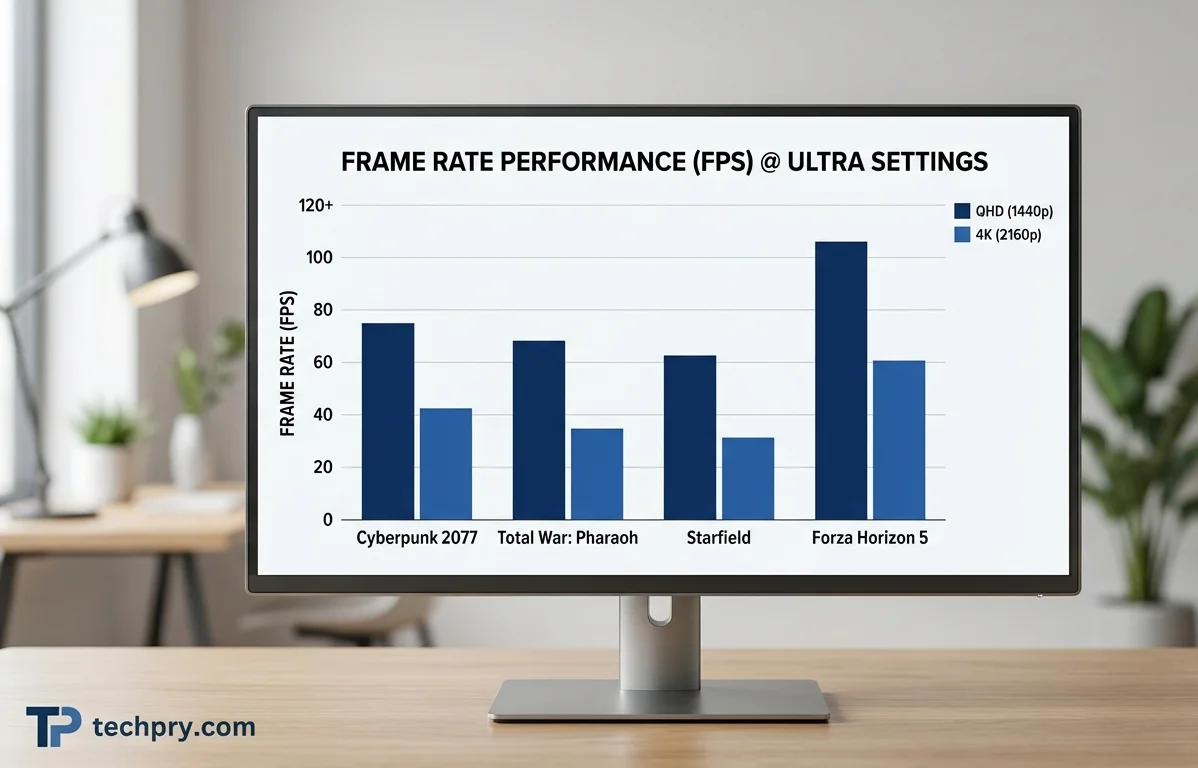
Frame rates stay at 36 fps or better at QHD in all four titles listed, but 4K splits them: reaches 49 fps and Total War Pharaoh 53, while and both fall to 25 fps .
| Game (fps) | Low | Medium | High | Ultra | QHD | 4K |
|---|---|---|---|---|---|---|
| Baldur's Gate 3 | 202 | 163 | 136 | 130 | 92 | 49 |
| Cyberpunk 2077 | 147 | 131 | 113 | 99 | 61 | 25 |
| Assassin's Creed Shadows | 73 | 66 | 60 | 42 | 36 | 25 |
| Total War Pharaoh | – | – | – | 55 | 55 | 53 |
Notebookcheck compiles these figures from laptop reviews, so they reflect whole machines rather than the GPU in isolation . Cyberpunk 2077 shows the steepest fall, from 99 fps at ultra to 61 at QHD and 25 at 4K, while Total War Pharaoh barely moves between ultra and 4K (55 to 53), which suggests something other than the GPU is setting the pace in that title at those settings . The listed purpose of the GPU is professional work , so these numbers are a side benefit rather than the reason to buy.
What it is: an integrated laptop GPU in the M5 Max, released March 3, 2026
Apple makes it, and it is an for laptops that was announced and released on March 3, 2026 . It belongs to the . The spec lists a professional purpose, a mid-range segment, the Apple M GPU architecture and a codename of simply Custom , and Notebookcheck classes its notebook size as large .
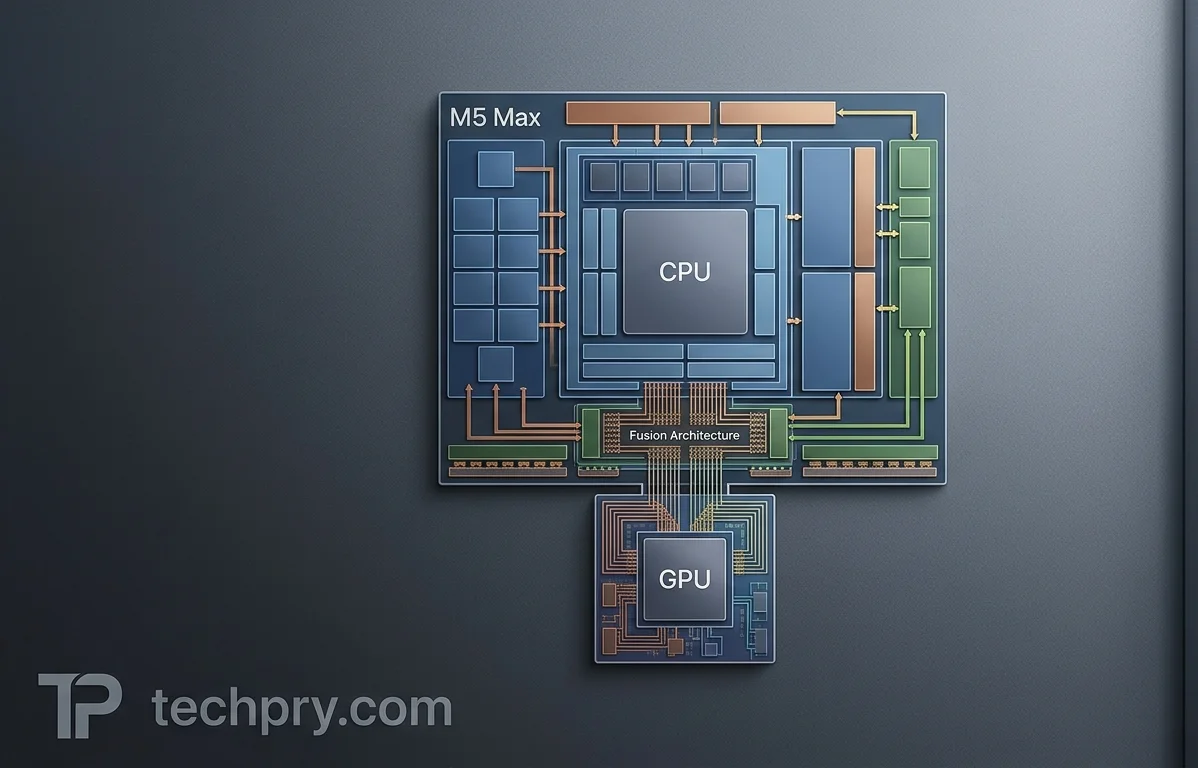
The GPU is used in the in its 40-core GPU configuration , and the recommended CPU is listed as the Apple M5 Max (40-core GPU) or above . Notebookcheck says the GPU sits on its own die, linked to the CPU through Apple's . That makes the word integrated less modest than it sounds: this is not a small block on the CPU die but a separate die with access to up to 128 GB of shared memory . Because it ships as part of the chip, choosing this GPU means choosing that chip configuration .
How many cores does it have, and how fast do they run?
This is the 40-core configuration, with 5120 , 320 , 160 and 640 compute units (pipelines), plus 40 ray tracing cores according to Notebookcheck; the M5 Max GPU also appears in a 32-core variant . It boosts to 1620 MHz at 2 instructions per cycle, for a of 259 GPixel/s and a of 518 GTexel/s .
Notebookcheck lists pipelines as 40 (unified) rather than 640 . That 40 matches the core count and the number of ray tracing cores, and Notebookcheck elsewhere describes the GPU as having 40 cores, so the likelier explanation is counting at a different level rather than a different chip .
The remaining numbers hang together. Multiply 5120 shading units by 2 instructions per cycle and 1620 MHz and the result is the listed 16.6 TFLOPS of FP32 . Multiply the clock by 160 ROPs and 320 TMUs and the fill rates of 259 and 518 follow . These counts describe conventional shader throughput; the gains Skorppio projects come from the matrix hardware instead .
Ray tracing, upscaling and API support
Ray tracing is supported, while , NVIDIA's upscaling technology, is not . Notebookcheck lists support for , Metal Performance Shader and , with the neural accelerators covered above providing the AI-specific hardware . The missing DLSS matters only for games or tools that depend on it, and the support list names only Apple's own frameworks, so anyone whose tools rely on a different stack should check compatibility before counting on the projected AI gains .
Manufacturing process, transistor count, power draw and thermal limit
manufactures the GPU on a , with a transistor count of 28 billion and a maximum temperature of 100°C . Notebookcheck lists its power consumption as 75 W ; treat that as a scale marker, since the draw in a given laptop depends on the machine and the workload. The interface is listed as Custom, which fits a GPU that ships as part of the chip rather than as a card .
Who it suits, and who should skip it
- It suits buyers whose obstacle is fitting very large models on one machine: the GPU can reach up to 128 GB of shared memory in full, which Skorppio argues could remove the memory ceiling NVIDIA cards hit on 70B+ models . It also suits professionals whose tools run on Apple's Core ML and Metal stack, which is what the support list names .
- Skip it if speed is what you are paying for, since Skorppio says NVIDIA keeps a large lead in raw compute, small-model speed and training . Skip it too if your workflow needs ECC memory or DLSS , if you expect 4K in heavy games, where two of the four listed titles fall to 25 fps , or if you won't buy on projections, since the roughly 70 TFLOPS FP16 figure and the 4× gain over the predecessor are estimates .
Comments 0
Please log in or sign up to comment.