
Apple M6 12-Core: Big CPU and GPU Gains, a 32 GB Cap and Who Should Upgrade
The M6 adds two CPU cores, two GPU cores and a 2 nm process, but gaming and local AI still run into integrated-graphics and 32 GB limits.
Contents
- Is the Apple M6 worth the upgrade, and where does the base chip fall short?
- How much faster is the M6's CPU than the M5, M4 and M4 Pro?
- M6 GPU benchmarks: how far ahead of the M5 and M4 is the 12-core GPU?
- Can the M6 handle games? 1080p frame rates and the limits as a gaming platform
- How much memory can the M6 take, and how fast is it? Up to 32 GB at 170 GB/s
- What is the M6 built on? A 2 nm process from TSMC
- M6 GPU specs: 12 cores, 1,536 shading units and 4.9 TFLOPS
- How the M6's 12 CPU cores are split across three core types
- On-device AI on the M6: dual 16-core design and GPU accelerators
- When did the M6 launch, which Mac uses it, and are higher-tier variants coming?
- How efficient is the M6, and who is it designed for?
- What the M6 is: an ARMv9 chip from Apple that succeeds the M5
- Clock speeds, cache and socket: 4.79 GHz P-core base and 8 MB shared L2
- Who should buy the M6 and who should skip it
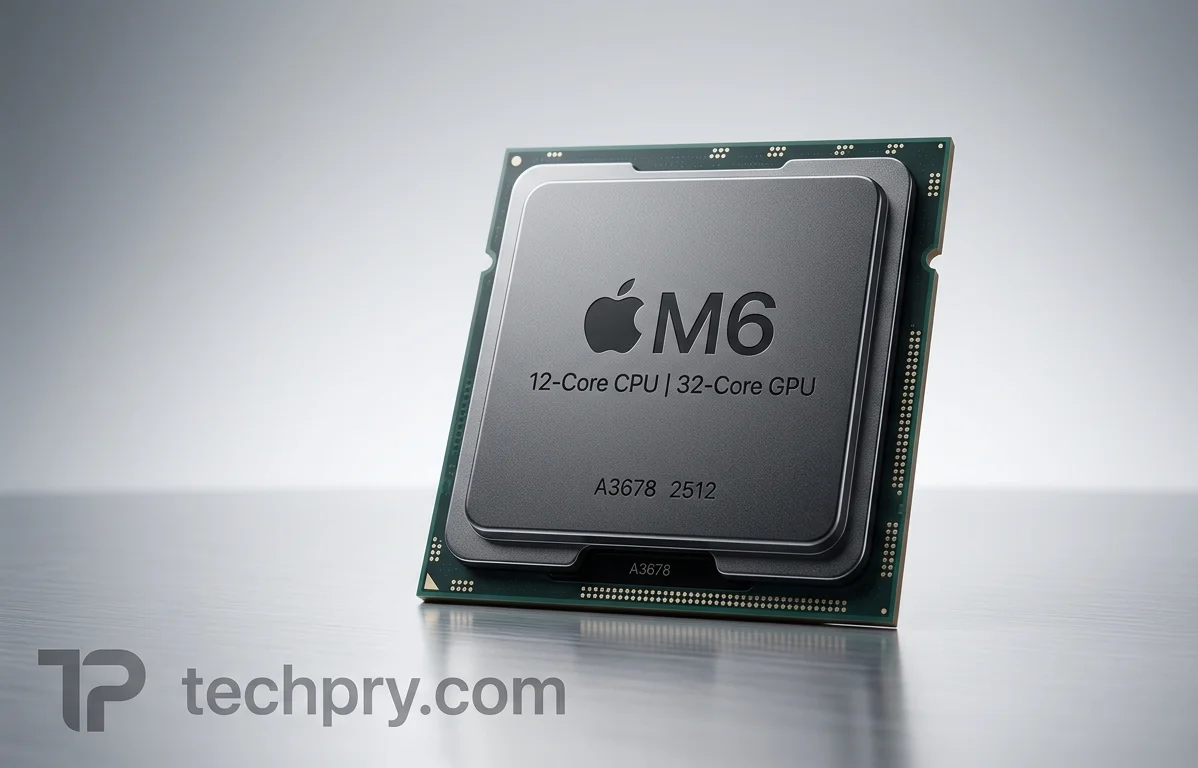
A base-tier chip that edges past last generation's 12-core Pro in a multi-core render test, yet still stops at 32 GB of memory: that tension runs through the whole Apple M6 story. CpuTronic says the M6 reaches the previous-generation Pro level in some pure-CPU cases, and the same review lists what Pro chips still do better, namely graphics, memory capacity and sustained professional workloads. The M6 is also the first M-series chip built on 2 nm, with 12 CPU cores and a 12-core GPU.
Is the Apple M6 worth the upgrade, and where does the base chip fall short?
The M6 is clearly worth it for owners of M1-M3 chips and only conditionally worth it from an , according to CpuTronic. For M1-M3 owners, that review describes a substantial gain in both CPU and graphics performance. From the M4, it says the move pays off for regular multi-threaded work, rendering, gaming or where the extra CPU and GPU resources actually get used. More broadly, CpuTronic describes the M6 as a large step over its predecessor, with the two added CPU cores most noticeable in multi-threaded work.
Apple's own framing is that the chip improves performance across the board, which is a vendor claim rather than an independent finding. Treat the upgrade advice as one outlet's judgment: it comes from CpuTronic, and CNET's first look offers no comparable verdict.
The same review is just as direct about limits. The base M6 is not a full replacement for Pro chips, which offer stronger graphics, a higher memory limit and more resources for sustained professional workloads. It also says the M6 remains limited as a gaming platform, and that for local AI the 32 GB memory cap may matter as much as raw compute. Put together, the M6's strengths show up where more cores and a bigger GPU help, and its weaknesses show up where memory capacity or sustained load decide the outcome.
How much faster is the M6's CPU than the M5, M4 and M4 Pro?
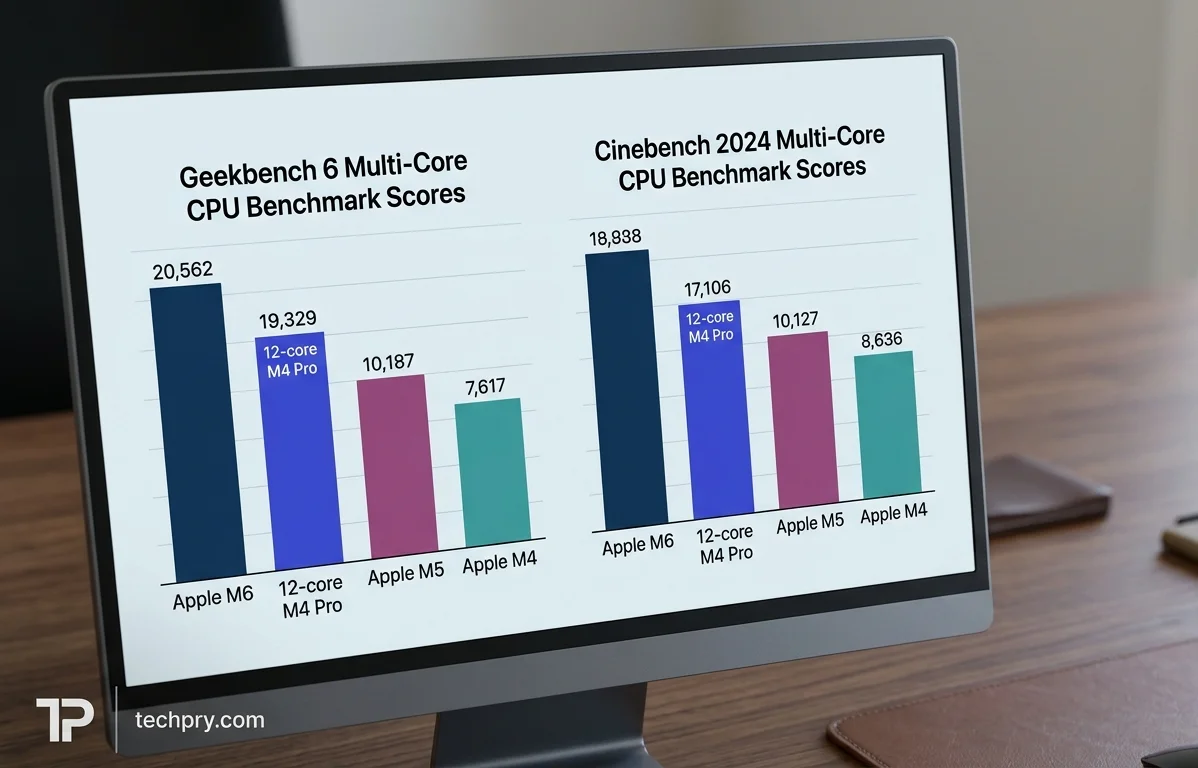
The M6 is about 20% faster than the M5 in heavy CPU work, 41% to more than 50% faster than the M4 in multi-core tests, and in one render benchmark it edges past a 12-core . Apple puts the gap over the M5 at up to 1.2x in multithreaded performance, and CpuTronic arrives at about 20%.
CpuTronic's table for the first production M6 computer lists 4698 single-core and 21302 multi-core in , and 221 and 1468 in . Here is how the gains break down:
| Test | M6 score | Lead over M5 | Lead over M4 |
|---|---|---|---|
| Geekbench 6 single-core | 4698 | about 9% | not given |
| Geekbench 6 multi-core | 21302 | about 18% | about 41% |
| Cinebench 2024 single-core | 221 | about 11% | not given |
| Cinebench 2024 multi-core | 1468 | about 25% | more than 50% |
The pattern is easy to read. The multi-core gains over the M5 (about 18% and 25%) are clearly larger than the single-core gains (about 9% and 11%), which matches CpuTronic's point that the two extra cores, rather than faster individual cores, drive the improvement. In practice, work that spreads across many cores, such as rendering and compiling code, captures most of the gain, while anything bound to a single thread sees a smaller bump.
Apple goes further, claiming the world's fastest single-threaded performance and up to 2.4x the speed of the M1. Both are Apple's own claims, and the single-core gain CpuTronic reports over the M5 is the smaller of the two kinds of gain it reports.
The M4 Pro comparison needs a caveat. The 1468 multi-core Cinebench 2024 score sits next to roughly 1455 for the 12-core M4 Pro, and CpuTronic concludes that in pure CPU terms the base M6 reaches the previous-generation Pro in some cases. The only head-to-head figure given is that single Cinebench result, and Pro chips keep their lead in graphics, memory ceiling and sustained load.
M6 GPU benchmarks: how far ahead of the M5 and M4 is the 12-core GPU?
The 12-core M6 GPU is about 35% ahead of the M5 in Steel Nomad Light, about 31% ahead in Wild Life Extreme and about 32% ahead in , according to CpuTronic. Against the M4, its lead in Steel Nomad Light is about 77%. The scores behind those percentages:
| Test | M6 (12-core GPU) | M5 (10-core GPU) | M4 (10-core GPU) |
|---|---|---|---|
| 3DMark Steel Nomad Light | 7069 | 5221 | 3989 |
| 3DMark Wild Life Extreme | 15842 | 12059 | not listed |
| Geekbench 6 Metal | 101981 | 77007 | 57948 |
Graphics is where the M6 improves most over the M5: GPU gains of roughly 31% to 35% outrun the CPU's multi-core gains of 18% to 25%. Two extra cores on a 10-core GPU look too small on paper to explain that alone, so the shader-core updates Apple lists and the roughly 10% bandwidth increase probably contribute as well. These are synthetic scores, and the game results below show how much of the lead carries into real play.
Can the M6 handle games? 1080p frame rates and the limits as a gaming platform
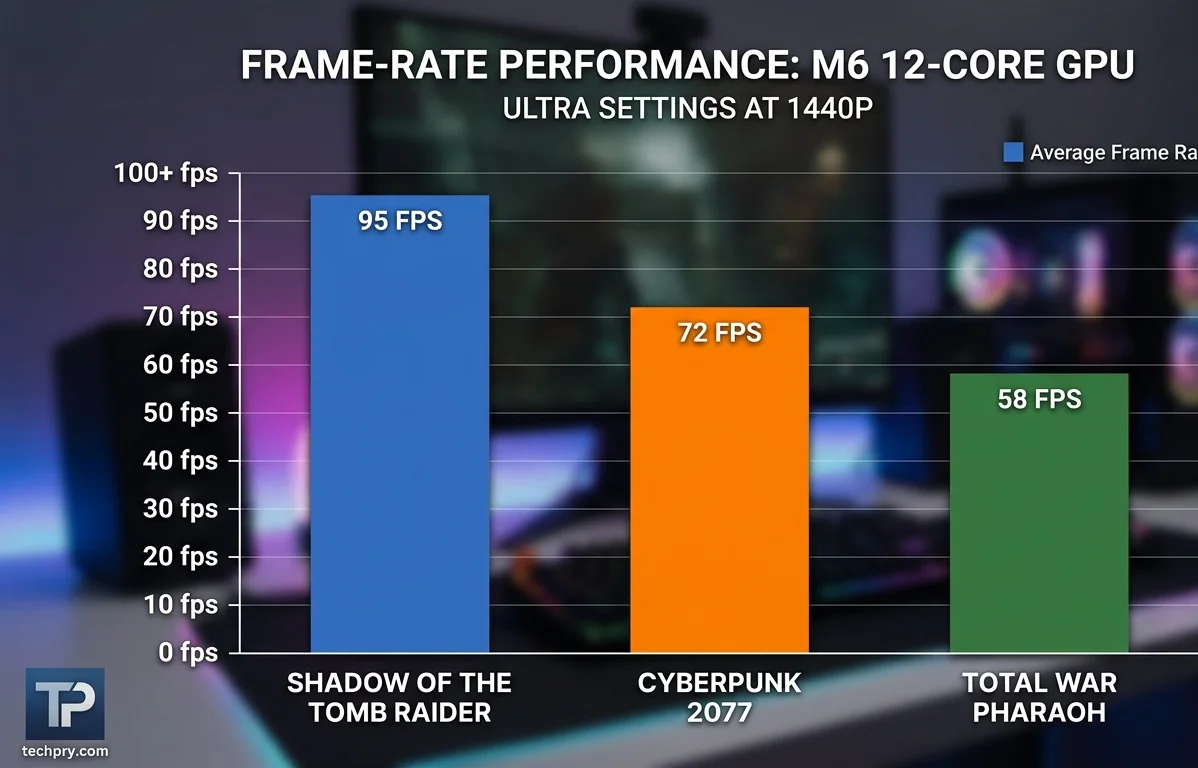
The M6 handles plenty of games at 1080p, though the heaviest ones need lower settings. In Notebookcheck's table, the M6 reaches 76 fps in Shadow of the Tomb Raider and 58.1 fps in at ultra settings, but only 37.5 fps in (without FSR) and 23 fps in Assassin's Creed Shadows. CpuTronic reports the same roughly 76 and 37.5 fps figures for its M6 system, and puts the M5 at 59 fps in the first game and 29.3 fps in the second, with the M4 at 41 fps in the first.
Notebookcheck's full table, in frames per second:
| Game | Low | Medium | High | Ultra | QHD |
|---|---|---|---|---|---|
| Shadow of the Tomb Raider | 184 | 95 | 86 | 76 | 53 |
| Baldur's Gate 3 | 84.8 | 69.6 | 59.4 | 58.1 | 39.3 |
| Total War Pharaoh | – | – | – | 50.6 | 45.6 |
| Cyberpunk 2077 | 72 | 55.1 | 43.8 | 37.5 | 21.1 |
| Assassin's Creed Shadows | 45 | 41 | 35 | 23 | 19 |
Frame rates fall quickly as settings or resolution rise. Cyberpunk 2077 runs at 72 fps on low but 37.5 at ultra and 21.1 at QHD, and Assassin's Creed Shadows goes from 45 fps on low to 23 at ultra and 19 at QHD. Baldur's Gate 3 and Total War Pharaoh both stay above 50 fps at ultra.
CpuTronic calls the 1080p performance reasonable, but says the macOS game selection and the limits of integrated graphics keep the M6 limited as a gaming platform. That second point is one a frame-rate table cannot show: a good result only helps if the game you want exists on macOS. Apple, for its part, credits GPU architecture updates, detailed in the GPU spec section below, for higher frame rates.
How much memory can the M6 take, and how fast is it? Up to 32 GB at 170 GB/s
The M6 supports up to 32 GB of -10667 with a peak bandwidth of 170 GB/s. The spec lists 8 memory channels, Wikipedia's configuration table lists 8 memory controllers, and ECC is not supported. The first M6 product starts at 16 GB.
Apple puts the 170 GB/s figure at 10% above the M5 and 2.5x the M1, and CpuTronic quotes the M5 at roughly 153 GB/s. The headline number does not apply to every configuration, though. Wikipedia's table lists 153.6 GB/s for the 16 GB version and 170 GB/s for 24 or 32 GB. On that table, the 16 GB starting configuration sits close to the M5's roughly 153 GB/s, and the bandwidth gain arrives only with the larger memory options.
Capacity is the other constraint. The maximum remained at 32 GB, and for local AI CpuTronic warns that memory capacity, not only compute, may be the limit, since Pro, Max and Ultra configurations are significantly more flexible for larger models. A model that does not fit in memory is a hard stop however fast the chip is, which is why the cap matters more to AI users than to people doing general work.
What is the M6 built on? A 2 nm process from TSMC
The M6 is built on a 2 nm process, and Apple, CNET, Wikipedia, Notebookcheck and CpuTronic all describe it that way. Wikipedia and Notebookcheck name TSMC as the manufacturer, with Notebookcheck specifying the process and adding that it uses , short for gate-all-around. Apple, CNET and Wikipedia each present the M6 as the first Apple chip built on 2 nm, and Wikipedia gives around 46 billion transistors.
That first matters when reading the benchmarks. A new process, two more CPU cores, two more GPU cores and updated GPU features all arrive in the same generation, so the gains over the M5 cannot be credited to the process alone.
M6 GPU specs: 12 cores, 1,536 shading units and 4.9 TFLOPS
The M6 integrates a 12-core GPU with 1,536 shading units and 4.9 TFLOPS of compute, two cores more than the M5's 10-core GPU. CNET notes that both the CPU and the GPU went from 10 cores in the M4 to 12.
- 96 TMUs and 80 ROPs.
- 192 execution units and 12 unified pipelines, as listed by Notebookcheck.
- Shared memory with the rest of the chip.
- 19 W power consumption, as listed by Notebookcheck.
On features, Apple and Wikipedia describe an updated shader core architecture alongside and , while CpuTronic's wording says Apple retained the last two, so they read as carried-over capabilities rather than debut features. Each GPU core also carries a Neural Accelerator, and Apple and Notebookcheck cite a 50% higher geometry rate for complex graphics. Because the GPU shares memory with the CPU, the 170 GB/s and 32 GB limits cover the whole chip rather than a graphics-only budget.
One entry disagrees: the spec lists a 1600 MHz GPU boost clock, whereas Notebookcheck lists 1700 MHz. The two are close enough that neither changes the benchmark picture.
How the M6's 12 CPU cores are split across three core types
The M6's 12-core CPU has two , four performance cores and six efficiency cores, for 12 threads in total and two more cores than the M5. The spec groups them differently: it lists 6 performance cores and 6 efficiency cores with 6 threads each, and its six P-cores correspond to the two super and four performance cores in the Apple, Wikipedia and CpuTronic breakdown.
Apple describes the roles this way: super cores take single-threaded work, performance cores use less power and join them for demanding multithreaded jobs, and efficiency cores handle everyday background tasks. With only two of the 12 cores in the single-thread role, the benchmark pattern makes sense: single-core gains over the M5 are modest at about 9% to 11%, while multi-core gains reach 18% to 25%. Against the M4's 10 CPU cores, the M6 adds two.
On-device AI on the M6: dual 16-core design and GPU accelerators
The M6 pairs a dual 16-core with a Neural Accelerator in every GPU core. CNET counts 32 cores combined, double the 16-core NPU of the M4 and M5 Pro, and Apple says system frameworks can use both engines at once.
Apple claims, and Wikipedia and CpuTronic repeat, up to twice the peak compute of previous generations from the Neural Engine. It also claims a nearly 30% increase in peak GPU compute for AI over the M5 and more than 8x over the M1, which it says enables significantly faster prompt processing with on-device LLMs. The chip also supports and Siri AI.
Every one of these AI figures is Apple's own, and they describe peak compute rather than finished tasks, so read them as direction rather than a measured speedup. They also address a different limit from the one CpuTronic raises: Apple's numbers are about compute speed, while CpuTronic's caveat is the 32 GB capacity ceiling for larger local models, and a faster engine cannot help a model that does not fit.
When did the M6 launch, which Mac uses it, and are higher-tier variants coming?
Apple announced the M6 on August 25, 2026, and the first Mac to carry it is the , a desktop rather than the laptop the spec sheet lists. A Bloomberg report from June 25, 2026, as relayed by Wikipedia, says Apple planned to skip M6 Pro and M6 Max variants.
Two spec entries are contradicted by other reporting. The spec lists August 25, 2026 as the release date, but Wikipedia treats that as the announcement and says the chip was released on September 22, 2026, while Apple's press release and Notebookcheck also date the announcement to August 25. The spec's type field says laptop, whereas CNET, Wikipedia, Apple and CpuTronic all place the first M6 device in the Mac mini, and CNET points out that it reached the chip ahead of every MacBook.
Wikipedia adds that the M6 is expected to stay in entry-level Macs and is the first Apple chip generation to launch with only a base chip. For buyers that matters more than it sounds: the limits CpuTronic flags, 32 GB of memory and graphics short of Pro chips, would normally be answered by a higher-tier chip, and a skipped tier means those limits may stand for the whole generation. Anyone waiting for an M6 laptop has no launch model to point to, since the first Mac is a desktop.
How efficient is the M6, and who is it designed for?
Efficiency is the part of the M6 story that rests mostly on Apple's word: Apple claims industry-leading CPU , with no measured efficiency result alongside it. Its reasoning is architectural, with performance cores using less power and efficiency cores handling background tasks. The one power number on record is the 19 W that Notebookcheck lists for the GPU.
Apple says the M6 is designed for everyday users, students, developers, AI hobbyists and enterprises, offering a balance of performance, power efficiency and on-device AI for daily tasks, coding and creative projects. It also says demanding CPU tasks such as editing images, compiling code, indexing new files and running agentic AI workloads are faster than ever. That list is broad. The independent results support a narrower reading, with the biggest gains in multi-core CPU work and graphics, which fits CpuTronic's advice that the extra resources only pay off where they are actually used.
What the M6 is: an ARMv9 chip from Apple that succeeds the M5
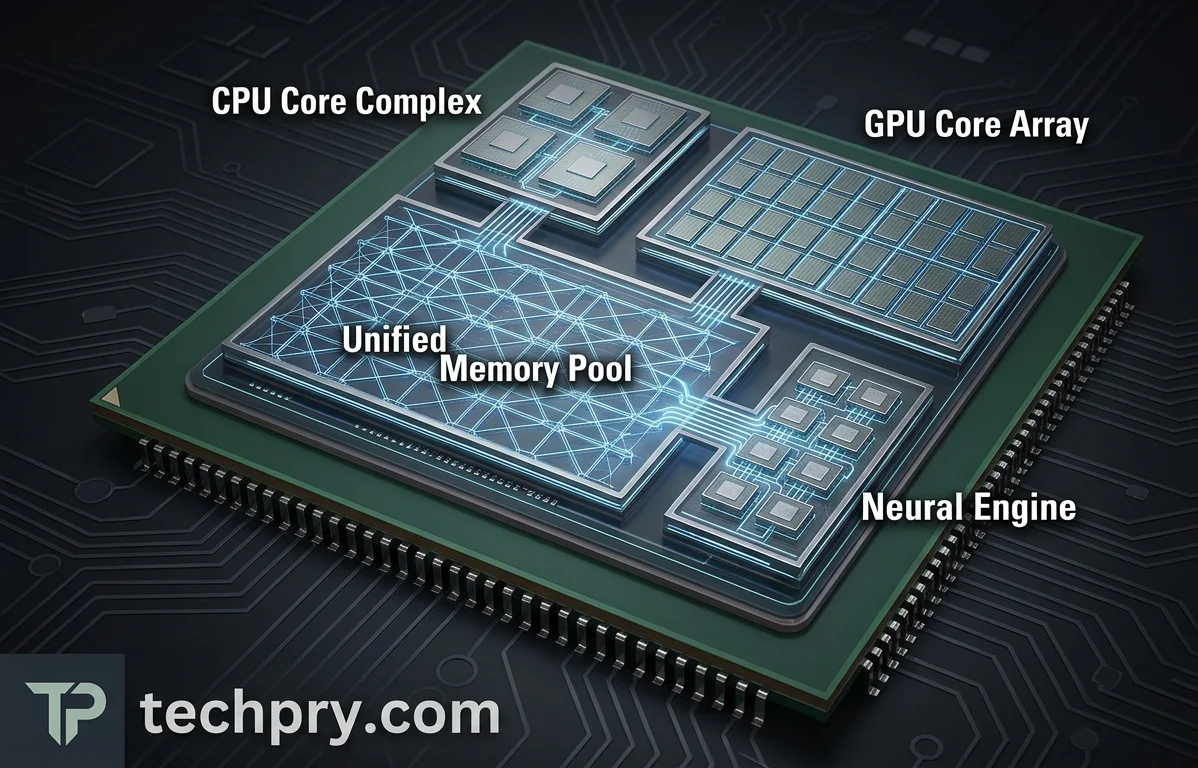
The M6 is an ARM-based system on a chip created by Apple, part of the family, built on the ARMv9 instruction set and the successor to the M5. It carries the codename Apple M6 and model number T8152. The CPU, GPU, NPU and unified memory sit in a single package, and the chip uses a single-die design. Wikipedia also mentions a with enhancements to video encoding and decoding, without giving figures.
Clock speeds, cache and socket: 4.79 GHz P-core base and 8 MB shared L2
The spec lists a 4.79 GHz base frequency for the performance cores, a 100 MHz bus frequency and a 47x multiplier. The multiplier is not unlocked, so none of these figures is something a buyer can tune. Cache is 256K of L1 per core and 8MB of shared L2, and the socket entry reads Apple M-Socket. Treat these as reference entries: the benchmark results earlier in the article say far more about real speed than a base frequency does.
Who should buy the M6 and who should skip it
- M1-M3 owners: the clearest case for upgrading, with a substantial CPU and graphics gain according to CpuTronic.
- M4 owners: worth it mainly for multi-threaded work, rendering, gaming or local AI that uses the extra cores, where the multi-core gap is about 41% in Geekbench 6 and more than 50% in Cinebench 2024.
- M5 owners: the weakest case, with single-core gains of about 9% to 11% and multi-core and GPU gains that matter only if those workloads are your bottleneck.
- Large local models or sustained professional loads: the 32 GB cap and the graphics gap to Pro chips are reasons to look elsewhere, and a higher M6 tier is reportedly not coming.
- Gamers: 1080p is reasonable at many settings, but the macOS game selection and integrated graphics keep the chip limited, and Assassin's Creed Shadows managed 23 fps at ultra.
- Laptop shoppers: the first M6 Mac is a desktop.
Comments 0
Please log in or sign up to comment.