
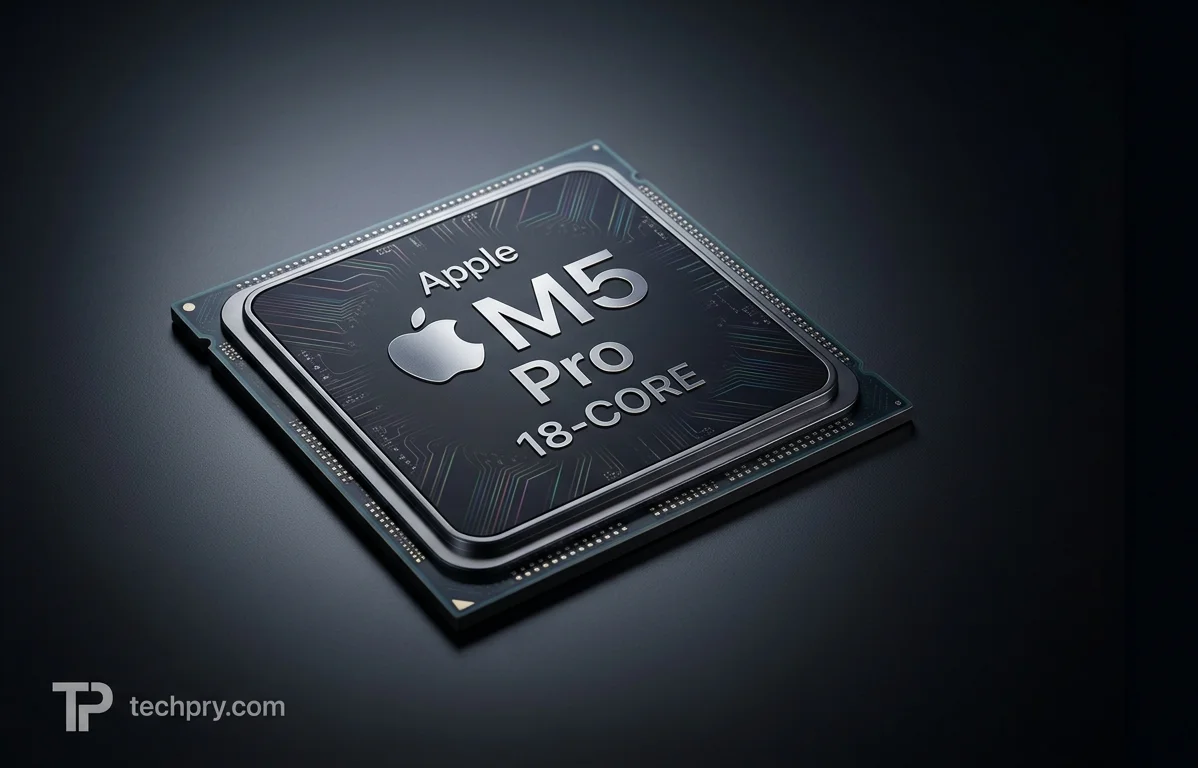
Apple M5 Pro 18-Core: Near M5 Max CPU Scores, Conflicting Spec Labels
Its single-thread ranking is near the top and its CPU Mark nearly equals a Max-class chip, but the spec pages split on core types and base clock.
Contents
- Release date and where it ships: March 3, 2026, in the MacBook Pro
- Process and packaging: TSMC N3P 3 nm, 28 billion transistors and a two-die package
- CPU cores and threads: 18 of each, split in two different ways
- Core design: 10-wide super cores versus 7-wide performance cores
- Clock speeds: a 4.6 GHz ceiling and a disputed base clock
- Cache: 192K L1 per core, 32 MB shared L2 and 24 MB L3
- Benchmark standing: 5th among 1652 laptop CPUs, and 5th of 6059 in single-thread
- Multi-thread speed: CPU Mark of 57,208 and a 216th-of-6059 overall rank
- PassMark sub-test scores: integer, floating point, encryption, compression and more
- Integrated GPU: 20 cores, 2560 shading units, a 1620 MHz boost clock and 8.3 TFLOPS
- GPU features: enhanced shader core, second-generation dynamic caching, mesh shading and ray tracing
- Memory: up to 64 GB of unified LPDDR5X-9600 at 307.2 GB/s, without ECC
- AI hardware: a 16-core Neural Engine and Neural Accelerators in every GPU core
- Against its siblings: the 15-core M5 Pro scores 14.2% lower, the M5 Max 18 Core about 1% higher
- Against the M4 Pro: up to 30% more multithreaded CPU performance and up to 20% more raw graphics performance
- Against Intel, AMD and Qualcomm laptop CPUs: within 3% of Core Ultra 9 HX chips, with several others scoring 13.7% to 40.7% lower
- Media Engine codecs and native Thunderbolt 5 controllers
- Power and thermal limits: 72 W TDP, 100°C peak temperature and 28 W GPU TGP
- Who the 18-core M5 Pro suits, and who can skip it
On CPU score alone, the 18-core M5 Pro is almost indistinguishable from the M5 Max 18 Core: the CPU Mark list at cpubenchmark.net puts the Max about 1% ahead, 57,753 against 57,208. Dropping to the 15-core M5 Pro costs 14.2% on the same list. Intel's Core Ultra 9 HX laptop chips land within about 3% of it, one slightly above and two below. The spec data is messier than the scores, though: core types and clock speeds are labeled differently depending on which page you read.
Release date and where it ships: March 3, 2026, in the MacBook Pro
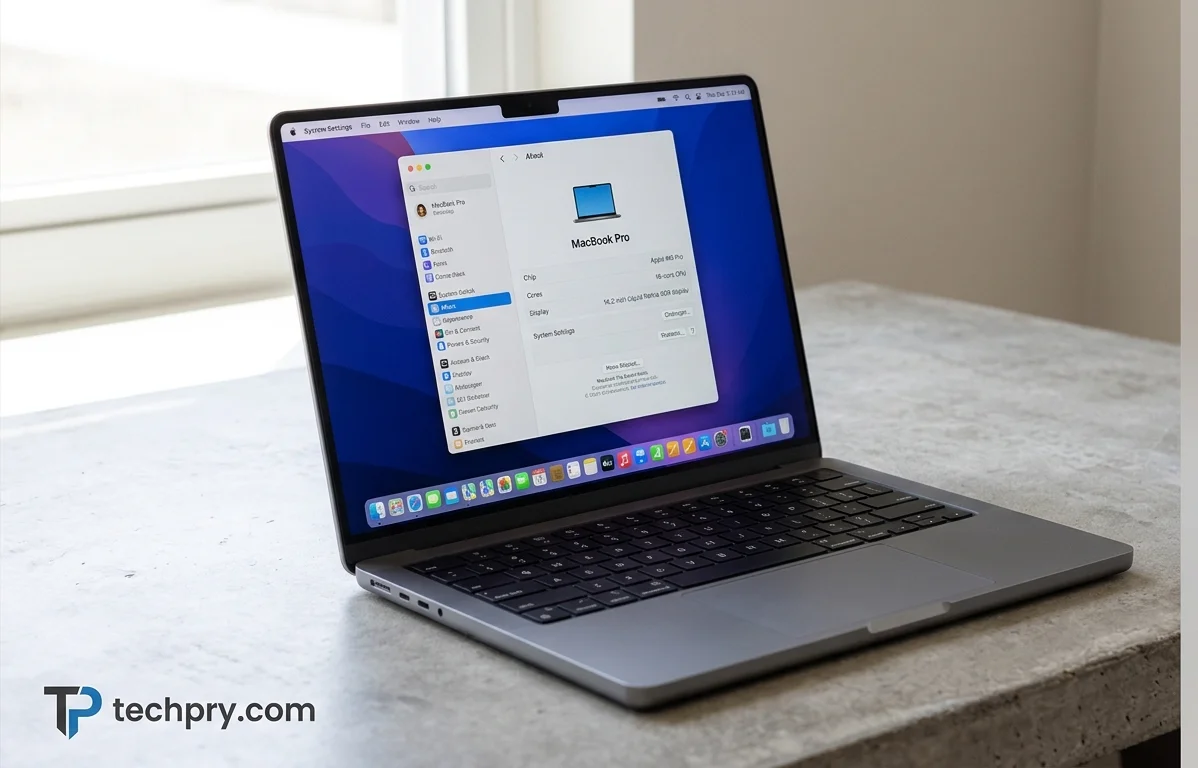
Apple released the M5 Pro 18-core on March 3, 2026, a date both the spec and Notebookcheck give. It debuted that March in the updated 14-inch and 16-inch MacBook Pro lineup, and the is the model sold with the 18-core version. Apple's tech specs page for that laptop lists the M5 Pro alongside the M5 Max as the chip options, and MacOne sells the 14-inch machine with the 18-core chip.
It is a laptop-class system-on-a-chip, which Notebookcheck describes as a high-end part designed for premium laptops. The instruction set is with 64-bit support, and the model number is T6050. The benchmark site cpubenchmark.net first charted it in Q1 2026.
Process and packaging: TSMC N3P 3 nm, 28 billion transistors and a two-die package
The chip is built on a 3 nm process, which the spec and Notebookcheck both list. Notebookcheck narrows that to TSMC's node and describes Apple's as running on a third-generation 3 nm process. The packaging is the less ordinary part: the SoC combines two dies into a single chip using , a technology Notebookcheck says is TSMC's only according to rumors.
The spec adds 28 billion transistors and a 166.85 mm² die, and lists the socket as Apple M-Socket. It gives a single die-size figure without saying whether it covers one die or both, so read that number with the two-die package in mind.
CPU cores and threads: 18 of each, split in two different ways
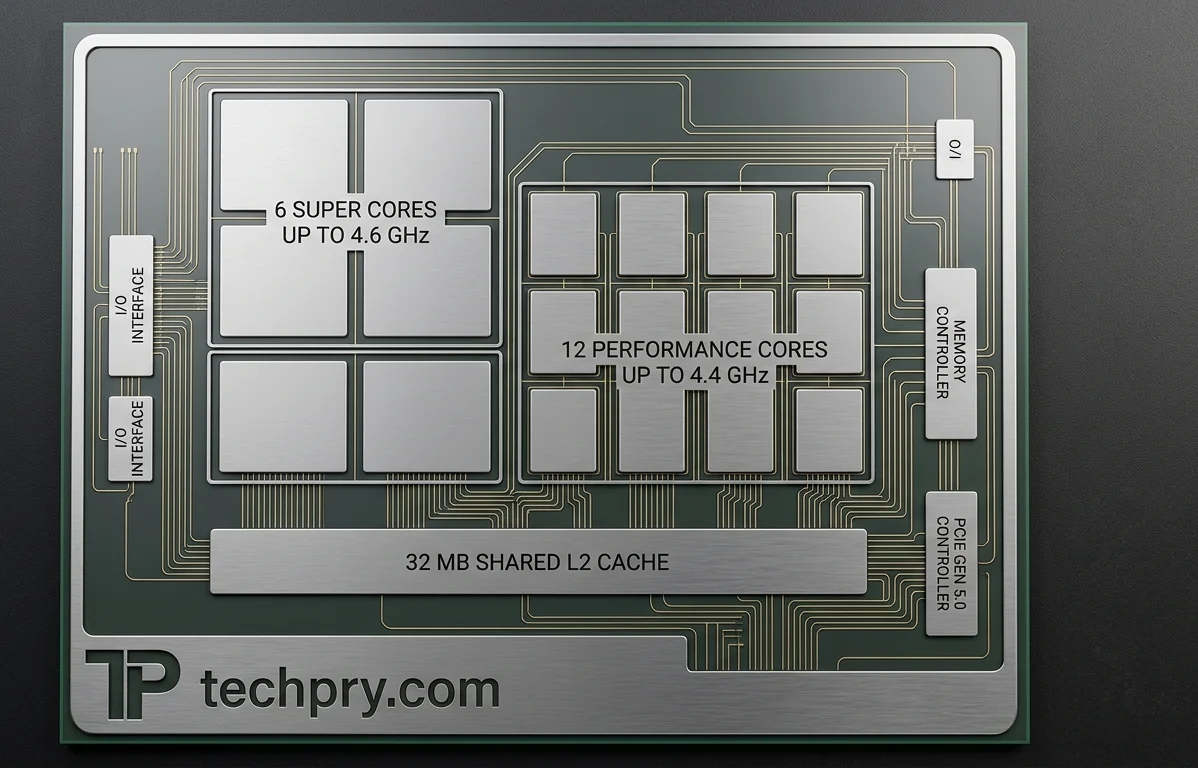
The chip has 18 cores and 18 threads, one thread per core, and Apple's tech specs page, Notebookcheck and cpubenchmark.net all divide them into six (primary cores, in cpubenchmark.net's wording) and twelve performance (secondary) cores. The spec sheet disagrees: it lists 18 performance cores and 18 performance threads, with no second tier.
Notebookcheck notes that the M5 Pro shifts Apple's core naming conventions. That probably explains the split. The spec's single performance bucket reads like the older vocabulary applied to a chip that now has two tiers, while the 6 + 12 breakdown is the one Apple's own tech specs page uses.
Buyers will also meet a smaller sibling. Apple's tech specs page shows a 15-core variant with 5 super cores, 10 performance cores and a 16-core GPU next to this 18-core, 20-core GPU version, and MacOne frames the 18-core as the step up from the 15-core.
Core design: 10-wide super cores versus 7-wide performance cores
According to Notebookcheck, the two tiers are built differently. The super cores use a 10-wide design that reaches up to 4.6 GHz, with an enhanced cache hierarchy and increased front-end bandwidth. The performance cores are 7-wide, reach up to 4.4 GHz and are optimized for power-efficient multithreaded work.
Notebookcheck's own estimate is that the performance cores offer around 70% of the performance of the super cores, slotting in between the efficiency cores of the (6-wide, 3.05 GHz) and the super cores. With top clocks of 4.6 GHz against 4.4 GHz, the gap it describes seems to come from design width and cache rather than frequency, though it is Notebookcheck's judgment, not a measurement.
The split points to a division of labor: six wide cores for lightly threaded work, and twelve cores optimized for efficient parallel load.
Clock speeds: a 4.6 GHz ceiling and a disputed base clock
The super cores top out at about 4.6 GHz, a figure Notebookcheck and cpubenchmark.net both give, but the base clock depends on the source: the spec lists 4.61 GHz for the P-cores, while cpubenchmark.net lists 1.3 GHz. The spec pairs its figure with a 100 MHz bus and a 46x multiplier that is not unlocked.
| Source | What it lists |
|---|---|
| Spec | 4.61 GHz P-core base frequency, 100 MHz bus, 46x multiplier, multiplier not unlocked |
| Notebookcheck | 3048 to 4608 MHz clock range; 4.6 GHz as the upper clock of the six super cores, 4.4 GHz for the twelve performance cores |
| cpubenchmark.net | 1.3 GHz base on both core groups; 4.6 GHz turbo on the six primary cores, 4.3 GHz on the twelve secondary cores |
Several details line up better than the labels suggest. The 46x multiplier on a 100 MHz bus works out to 4.6 GHz, and the top of Notebookcheck's range, 4608 MHz, rounds to the spec's 4.61 GHz. That points to the spec's base-frequency entry actually recording the peak clock. The performance-core ceiling also differs by a notch, 4.4 GHz at Notebookcheck and 4.3 GHz at cpubenchmark.net.
The usable takeaway is the 4.6 GHz peak. The multiplier is locked, so there is no tuning headroom to chase, and nothing in these figures says how long the chip holds that peak under sustained load.
Cache: 192K L1 per core, 32 MB shared L2 and 24 MB L3
The cache is 192K of L1 per core and 32 MB of shared L2, and Notebookcheck confirms the L2 figure. Notebookcheck alone adds 24 MB of L3. Because the L2 is shared, the 32 MB is a pool the cores draw on together, not a per-core amount.
Benchmark standing: 5th among 1652 laptop CPUs, and 5th of 6059 in single-thread
's cpubenchmark.net ranks the chip 5th fastest out of 1652 laptop CPUs. In single threading it is also 5th out of 6059 CPUs, with a Single Thread rating of 5,931 MOps/Sec.
Notebookcheck's single-thread read is a projection, not a measurement. It expects results comparable to the Apple M5, which topped its 6.5 Single charts, and credits the super cores' enhanced cache hierarchy and front-end bandwidth. Its overview also describes the super cores as delivering the world's fastest single-threaded performance. PassMark's 5th place is consistent with a top-tier result but does not by itself confirm first place.
Both verdicts are positive, but one is an expectation drawn from the architecture and the other is a database ranking, so they support each other without settling the question.
Multi-thread speed: CPU Mark of 57,208 and a 216th-of-6059 overall rank
Across all 6059 CPUs, PassMark has the chip 216th fastest in multithreading, with an average CPU Mark of 57,208. Notebookcheck expects it to outperform the older 16-core and sit at the top of the mobile SoC class, again an expectation rather than a measured result.
Next to its 5th place in single-thread, 216th shows a profile that leans toward fast individual cores more than all-core throughput. For a laptop buyer the laptop-only rank, 5th of 1652, is the more relevant yardstick, since 216th place is measured against a wider pool of 6059 CPUs.
The five latest baselines, from Oct 16 to Oct 24, 2026, range from 43,842 to 60,106. Four of them fall between 58,764 and 60,106, all above the 57,208 average, and the Oct 23 baseline at 43,842 is the outlier, which suggests low runs are pulling the average down. A single CPU Mark figure for this chip is best read as a typical value, not a guarantee.
PassMark sub-test scores: integer, floating point, encryption, compression and more
Eight sub-tests sit behind the CPU Mark, and the headline pair is 132,763 MOps/Sec in Integer Math and 186,686 MOps/Sec in Floating Point Math. The full set is below.
| Test | Score |
|---|---|
| Integer Math | 132,763 MOps/Sec |
| Floating Point Math | 186,686 MOps/Sec |
| Find Prime Numbers | 488 Million Primes/Sec |
| Random String Sorting | 85,885 Thousand Strings/Sec |
| Data Encryption | 40,972 MBytes/Sec |
| Data Compression | 699,071 KBytes/Sec |
| Physics | 5,712 Frames/Sec |
| Extended Instructions | 33,576 Million Matrices/Sec |
These scores come without a verdict, and the units change from test to test, so each number is only useful against the same test on another chip's page. The encryption and compression rows show the trap: one is quoted in MBytes per second and the other in KBytes per second, so the larger-looking compression number says nothing about which task is faster.
Integrated GPU: 20 cores, 2560 shading units, a 1620 MHz boost clock and 8.3 TFLOPS
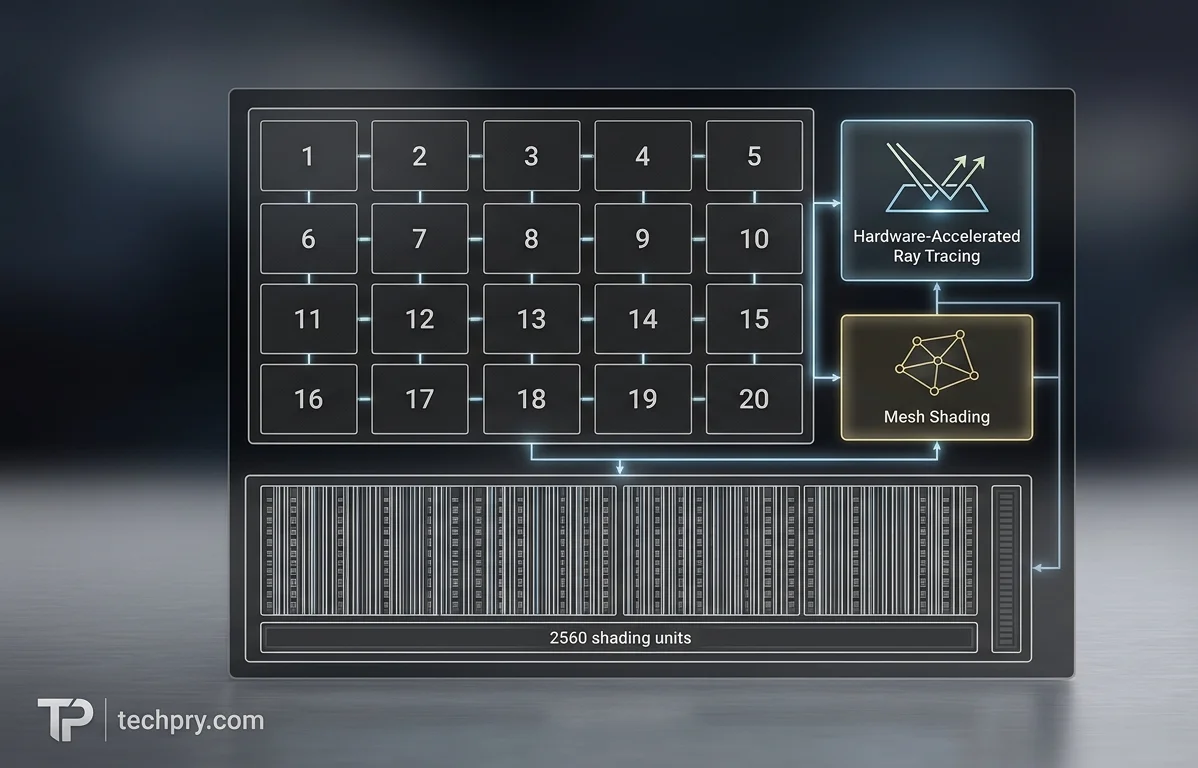
The integrated GPU is the 20-core Apple M5 Pro GPU, a configuration the spec, Notebookcheck, Apple's tech specs page, cpubenchmark.net and MacOne all list. It runs at a 1620 MHz boost clock with 2560 shading units, 160 TMUs, 80 ROPs and 320 execution units, for 8.3 TFLOPS. The listed TGP is 28 W.
TFLOPS measures theoretical shader throughput, so 8.3 says little about real game or render speed by itself. The only relative performance figure attached to the GPU is the up-to-20% claim over the M4 Pro in the next section, and the 20-core count matters when comparing models, since the 15-core variant carries a 16-core GPU.
GPU features: enhanced shader core, second-generation dynamic caching, mesh shading and ray tracing
Notebookcheck lists an enhanced shader core, second-generation and hardware-accelerated , and Apple's tech specs page adds hardware-accelerated . Notebookcheck also puts the GPU at up to 20% higher raw graphics performance than the M4 Pro.
Each of these claims rests on a single page. The shader, caching and mesh-shading items appear only in Notebookcheck's overview, ray tracing only in Apple's listing, and the 20% figure is a best-case ceiling rather than a typical gain.
Memory: up to 64 GB of unified LPDDR5X-9600 at 307.2 GB/s, without ECC
The chip supports up to 64 GB of , a ceiling the spec, Notebookcheck, Apple's tech specs page, cpubenchmark.net and MacOne all give. The memory type is -9600 and the bandwidth is 307.2 GB/s, which Notebookcheck and Apple round to about 307 GB/s; the spec also lists 16 memory channels.
The spec states that is not supported, so error-correcting memory is not an option on this chip. Because the memory is unified, the CPU and GPU draw on the same pool, which makes 64 GB the combined ceiling rather than a CPU-only figure. Anyone whose workload needs more than that, or needs ECC, has to look elsewhere.
AI hardware: a 16-core Neural Engine and Neural Accelerators in every GPU core
The chip carries a 16-core , which Notebookcheck, Apple's tech specs page and MacOne all list, plus that Notebookcheck places inside each GPU core. Notebookcheck says the combination pushes over 4x the peak GPU compute for AI compared to its predecessor, and calls the result a nice bump in AI performance.
Those two descriptions sit oddly together: 4x is a large multiple, and a nice bump is a modest verdict. The difference is in what is measured. The 4x figure is peak GPU compute for AI against an unnamed predecessor, not Neural Engine speed or the time a real app takes, so it describes headroom in the GPU rather than a promise that every AI workload runs four times faster. Software that puts its machine-learning work on the GPU stands to gain the most.
Against its siblings: the 15-core M5 Pro scores 14.2% lower, the M5 Max 18 Core about 1% higher
In cpubenchmark.net's CPU Mark list, the scores 49,093, which is 14.2% below the 18-core's 57,208, while the 18 Core scores 57,753, about 1% above it.
The step down in the lineup is concrete: the 15-core has 5 super cores, 10 performance cores and a 16-core GPU, so the 18-core adds three CPU cores and four GPU cores. The CPU score falls by a little less than the core count does, so scaling from 15 to 18 cores is close to linear but not quite.
The Max's CPU score is, for practical purposes, the same as this chip's. Whatever would justify the Max over the 18-core M5 Pro has to come from somewhere other than CPU Mark.
Against the M4 Pro: up to 30% more multithreaded CPU performance and up to 20% more raw graphics performance
Notebookcheck relays Apple's claim that the new configuration gives up to a 30% increase in multithreaded performance for demanding pro workloads compared to the . Notebookcheck separately puts the GPU at up to 20% higher raw graphics performance than the M4 Pro.
Both figures are single-source and both say up to, so they are best-case numbers: one is the maker's own claim, the other a statement from one outlet. The gains are also uneven. Next to the 30% and 20% claims sits the over-4x peak GPU compute for AI that Notebookcheck cites, so the generational step looks biggest for AI work.
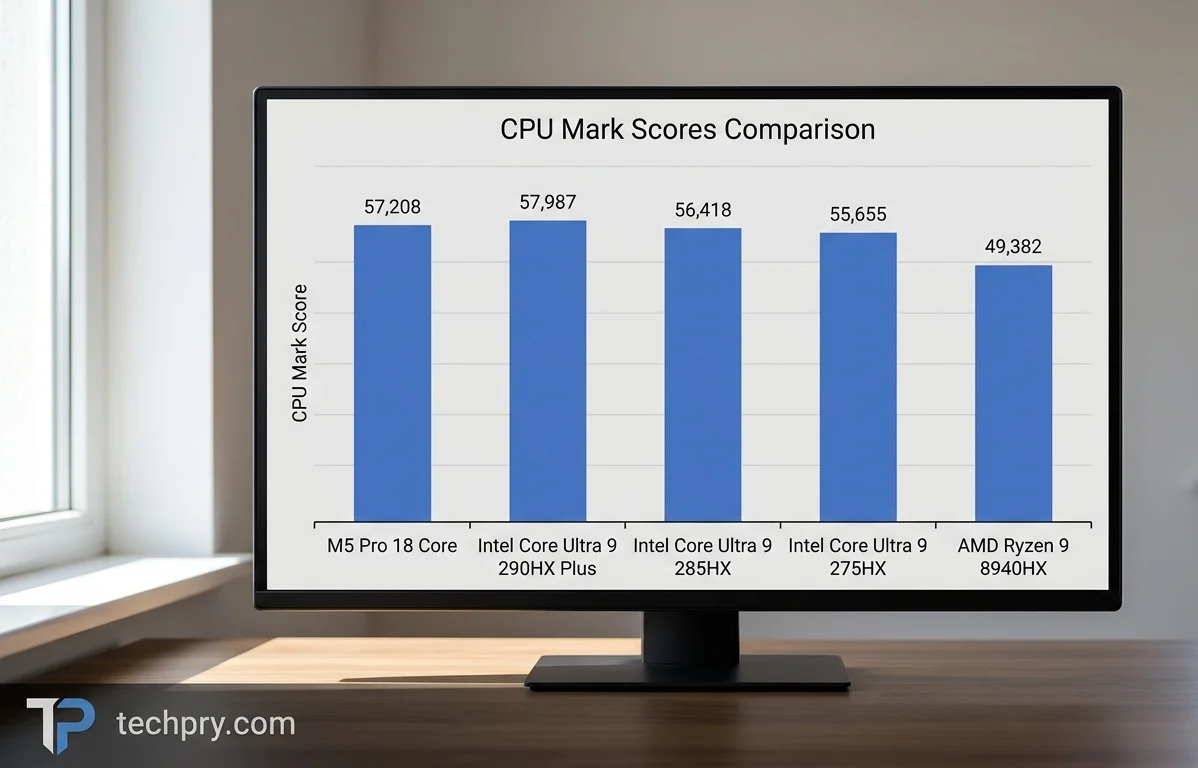
Against Intel, AMD and Qualcomm laptop CPUs: within 3% of Core Ultra 9 HX chips, with several others scoring 13.7% to 40.7% lower
On cpubenchmark.net's CPU Mark list, three Intel Core Ultra 9 HX laptop chips, including the , land within about 3% of the 18-core M5 Pro, while the and several Core Ultra 7 chips score 13.7% to 40.7% lower. The spec names the Qualcomm (X2E-96-100) as this chip's Qualcomm equivalent, but the table below has no score for it.
| Chip | CPU Mark | Versus the M5 Pro 18 Core |
|---|---|---|
| Intel Core Ultra 9 290HX Plus | 57,987 | +1.4% |
| Apple M5 Pro 18 Core | 57,208 | reference |
| Intel Core Ultra 9 285HX | 56,418 | -1.4% |
| Intel Core Ultra 9 275HX | 55,655 | -2.7% |
| AMD Ryzen 9 8940HX | 49,382 | -13.7% |
| Intel Core Ultra 7 270HX Plus | 48,925 | -14.5% |
| Intel Core Ultra 7 255HX | 47,950 | -16.2% |
| Intel Core Ultra 7 265HX | 47,481 | -17.0% |
| Intel Core Ultra 7 251HX | 47,130 | -17.6% |
| Intel Core Ultra 7 265H | 33,953 | -40.7% |
The 18-core M5 Pro sits inside the Core Ultra 9 HX pack rather than clear of it, since the 290HX Plus edges ahead by 1.4%. It does lead the Core Ultra 7 HX chips and the Ryzen 9 8940HX by a wide margin. This is one benchmark on one list, and CPU Mark measures speed, not power draw or battery life, so it says nothing about efficiency.
Media Engine codecs and native Thunderbolt 5 controllers
The Media Engine accelerates H.264, HEVC and ProRes in hardware, with ProRes encode and decode, and decodes , and Notebookcheck says the SoC has native, on-chip controllers for . Apple's tech specs page adds hardware-accelerated .
Two details matter for video work. The AV1 listings cover decoding only, so there is no hardware AV1 encode on the list. ProRes RAW and the Thunderbolt 5 controllers each appear on just one page, so those claims have a single source apiece.
Power and thermal limits: 72 W TDP, 100°C peak temperature and 28 W GPU TGP
The spec lists a 72 W TDP (PL1), a 100°C peak temperature and a 28 W TGP for the integrated GPU. These three figures come from the spec alone, and the other pages do not repeat them. They also describe the chip, not any laptop: battery life and sustained clocks depend on how a given MacBook Pro cools and limits power, and the 28 W GPU figure is listed separately from the 72 W package figure without saying how the two combine under load.
Who the 18-core M5 Pro suits, and who can skip it
It fits buyers whose work is CPU-bound and who want the top of the M5 Pro range. Its CPU Mark is within about 1% of the M5 Max 18 Core, and it ranks 5th of 6059 CPUs in single-thread. Video work gets a 20-core GPU, up to 64 GB of unified memory and hardware ProRes and AV1 decoding, and GPU-based machine-learning work gets the Neural Accelerators Notebookcheck describes.
It is easier to skip if your needs are lighter or more specific. The 15-core variant gives up 14.2% of CPU Mark and four GPU cores, which may be a fair trade for lighter workloads. Buyers who need ECC memory, more than 64 GB, or hardware AV1 encoding should look elsewhere, because none of the three is listed for this chip. Anyone who wants measured efficiency or sustained-clock data will find only a spec-sheet 72 W TDP and 100°C peak temperature, which say little about real laptop behavior.
Comments 0
Please log in or sign up to comment.