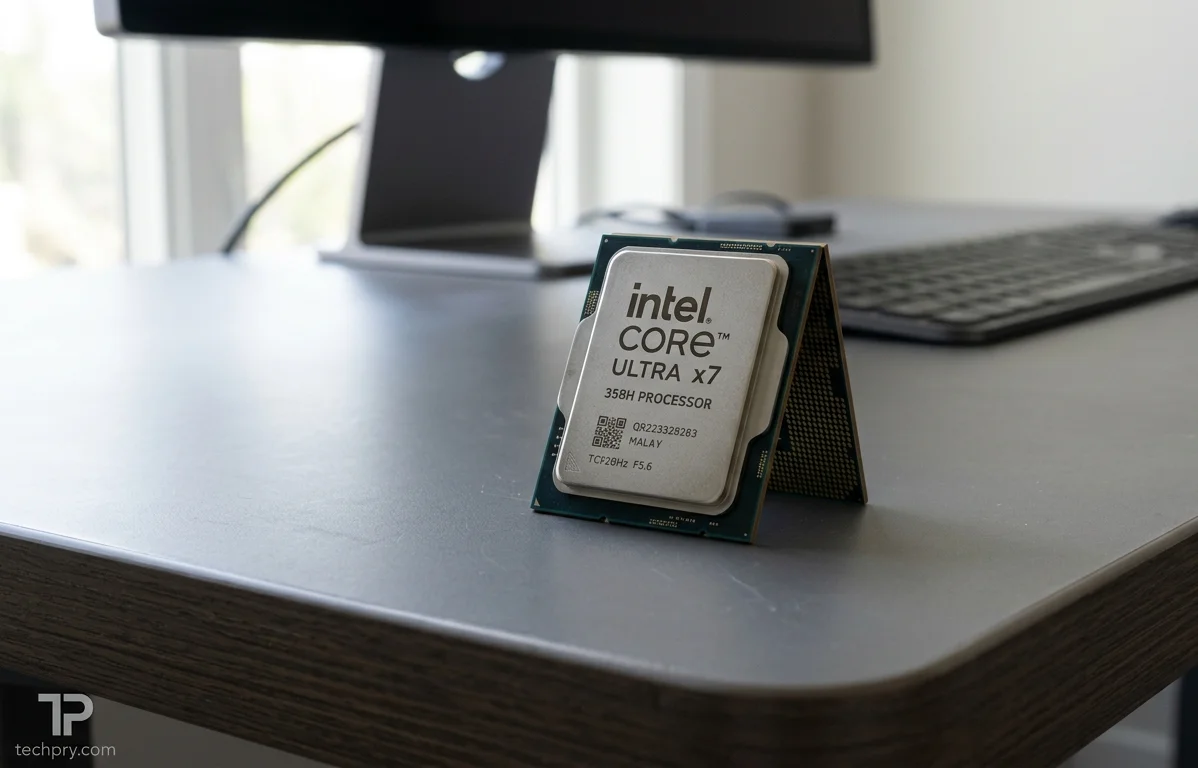
Intel Core Ultra X7 358H rating
Calculated by TechPry from the specifications and test results of the selected configuration. Scale 0–100, higher is better.
100*
Overall scoreExcellent
-
Efficiency
100*
-
Integrated graphics
100
Intel Core Ultra X7 358H at a glance
Strengths and weaknesses of the selected configuration compared with other processors.
Strengths
- Efficiency100/100*Excellent
- Integrated graphics100/100Excellent
- Process node2 nmBetter than 93% of processors
- Boost clock2500 MHzBetter than 80% of processors
No standout strengths.
Weaknesses
- Base clock300 MHzWorse than 80% of processors
No notable weaknesses.
Scores and values marked with a red asterisk (*) are approximate, as we currently do not have sufficient test results to make a precise estimation.
Intel Core Ultra X7 358H price
Price -
Compare Intel Core Ultra X7 358H with other processors
Full specifications
Detailed specifications, tests, and benchmarks of the Intel Core Ultra X7 358H
Overview
| Vendor | Intel |
|---|
| Released | January 5, 2026 |
|---|
| Segment | Laptop |
|---|
| Instruction set | x86-64 |
|---|
| Codename | Panther Lake |
|---|
| Model number | 358H |
|---|
| Integrated graphics | Arc B390 |
|---|
Cores and cache
| Cores | 16 |
|---|
| Threads | 16 |
|---|
| Bus frequency | 100 MHz |
|---|
| Multiplier | 19x |
|---|
| L1 cache | 192K (per core) |
|---|
| L2 cache | 3MB (per core) |
|---|
| L3 cache | 18 MB |
|---|
| Unlocked | No |
|---|
Package
| Process node | 2 nm |
|---|
| TDP | 15-25 W (configurable) |
|---|
| Socket | FCBGA2540 |
|---|
| Max temperature | 100°C |
|---|
| Max. Boost TDP (PL2) | 80 W |
|---|
Integrated graphics
| Model | Intel Arc B390 |
|---|
| Base clock | 300 MHz |
|---|
| Boost clock | 2500 MHz |
|---|
| Shader units | 1536 |
|---|
| TMUs | 48 |
|---|
| ROPs | 24 |
|---|
| Execution units | 12 |
|---|
| TGP | 30 W |
|---|
| FP32 performance | 7.7 TFLOPS |
|---|
Memory support
| Memory types | - LPDDR5X-9600 |
|---|
| Max memory | 96 GB |
|---|
| Channels | 2 |
|---|
| ECC | No |
|---|
| Max. Memory Bandwidth | 153.6 GB/s |
|---|
Misc
| Official site | Intel Core Ultra X7 358H official page |
|---|
| PCIe version | 5.0 |
|---|
| PCIe lanes | 12 |
|---|
Efficient Cores
| E-Cores | 12 |
|---|
| E-Threads | 12 |
|---|
| Base Frequency (E) | 1.5 GHz |
|---|
| Turbo Boost Frequency (E) | 3.5 GHz |
|---|

Comments 0
Please log in or sign up to comment.